
Your Funnel Isn’t Broken. Your Offer Is.
The conversation you've been avoiding for six optimization cycles (And yes, that includes the button color test.) Go Go Captain™ Notes — THE ANGRY STRATEGIST

I need to tell you something you don’t want to hear.
You’ve redesigned the landing page four times. You’ve A/B tested the headline, the hero image, the button color, the form length, and the social proof placement. You’ve hired a CRO agency. You’ve watched the heatmaps like they’re Netflix true crime. You’ve done everything the conversion optimization playbook says to do.
And it’s still not converting.
So you blame the traffic.
“The leads aren’t qualified.” You blame the algorithm. “Facebook doesn’t work like it used to.” You blame the economy. “People aren’t buying right now.”
You blame everything except the thing that’s actually broken.
Your offer is mid. At best.
And no amount of funnel optimization fixes a product people don’t actually want.
That’s like putting a spoiler on a minivan and wondering why it still can’t do 0-60 in four seconds. The problem isn’t aerodynamics. The problem is you’re still driving a Dodge Caravan. 🤮
The Offer vs. The Product: A Love Story That Ends in Therapy
Here’s where most people get it twisted:
Your offer isn’t your product.
Your product is the thing you made. The course. The coaching. The SaaS. The physical widget.
Your offer is the transaction you’re proposing: What they get. What they pay. And why it’s worth it.
It’s the deal.
Let me show you what I mean:
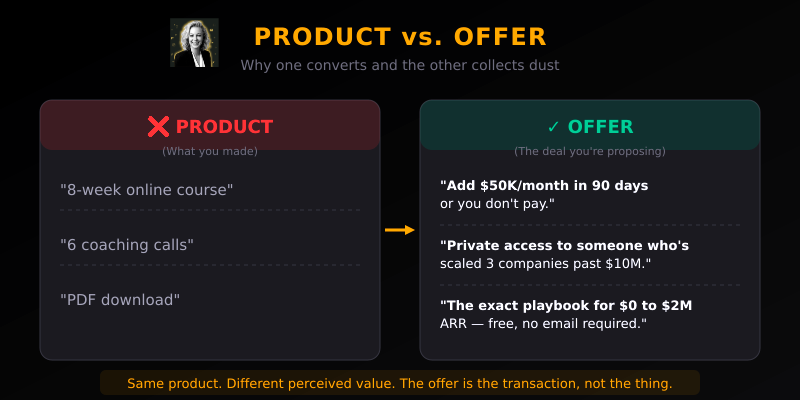
Same products. Wildly different value perception.
Your product is what you built. Your offer is how you frame the transaction so it feels like a no-brainer.
And here’s the brutal truth most funnel obsessives miss: most offers are built backward.
They start with what you have to sell, then try to figure out how to convince people to buy it.
That’s the wrong order.
Strong offers start with what people desperately want, then engineer a way to deliver it.
The direction matters.
The Three Horsemen of the Offer Apocalypse
If your offer isn’t converting, it’s usually one of three problems.
Actually, let me be more specific: it’s always one of these three problems. I’ve reviewed thousands of funnels. Managed $30-50M/month in ad spend. Watched more VSLs than any human should be legally allowed to endure.
And it’s always one of these:
1. The Outcome Isn’t Specific Enough
“Transform your business” isn’t an offer. It’s a Hallmark card.
“Add $50K/month in revenue within 90 days” is an offer.
People don’t buy transformation. They buy specific results they can picture.
I call this the Movie Trailer Test:
Can they see the “after” in their head like a movie scene?
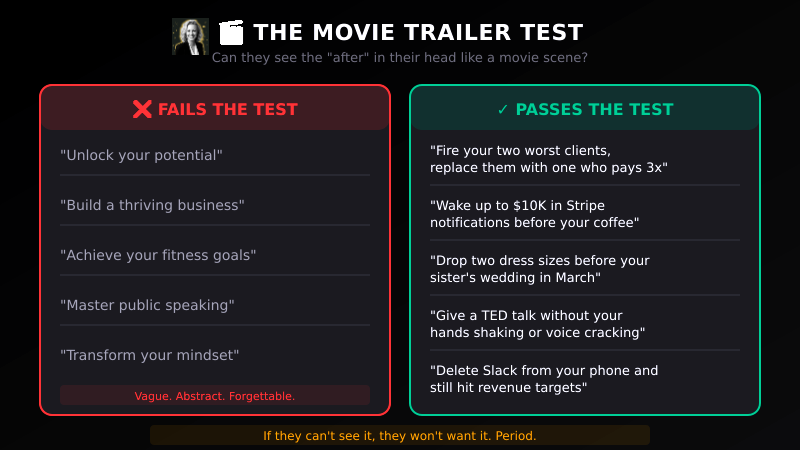
If they can’t see it, they won’t want it. Period.
2. The Risk/Reward Ratio Is Off
They’re being asked to risk too much — money, time, reputation — for an outcome they’re not sure you can deliver.
Think of every purchase as a mental equation:
When the top number is massive and the bottom number is tiny? They buy.
When both numbers are similar? They “need to think about it.”
When the bottom is bigger than the top? They bounce.
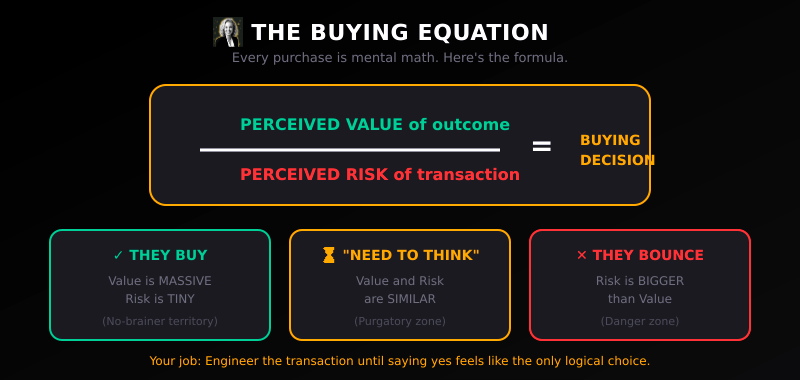
Your job is to engineer the transaction until saying yes feels like the obvious choice.
Here’s how the pros do it:
3. It Doesn’t Solve a Bleeding Neck Problem
Here’s where most “transformational” offers go to die.
They solve a nice to have. Something they’ll get around to eventually. Something that would be good for them in theory.
But it doesn’t solve something that’s actively costing them sleep, money, or sanity right now.
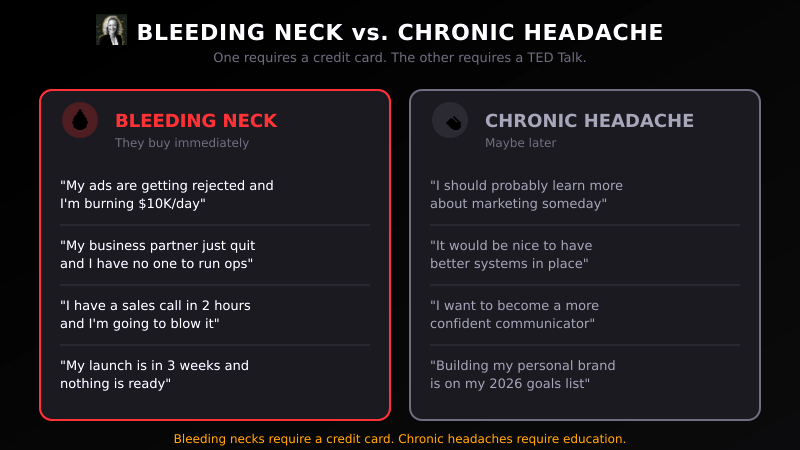
Nice-to-have offers require education. You have to convince them there’s a problem worth solving.
Bleeding-neck offers require a credit card. The convincing already happened — life did it for you.
If your conversion rate sucks, you’re either:
Selling to the wrong urgency level, or
Framing the problem without enough pain
More on this in a minute. First, let me tell you about the time I learned this the hard way.
The Case Study That Taught Me This (And Almost Killed a Launch)
Years ago, I was working on a launch for a coaching program.
High-ticket. Good product. Experienced coach with real results.
The kind of client that makes you think, “This should be easy.”
(Narrator: It was not easy.)
We built the funnel by the book:
VSL with all the right hooks
Webinar with the standard pitch stack
Application call sequence
Email nurture on autopilot
The whole machine. Shiny. Optimized. Ready to print money.
It flopped.
Not a total disaster — we had some sales. But nowhere near what the ad spend should have produced.
And here’s the weird part: the funnel metrics looked fine until the application stage. People were watching the webinar. They were staying to the end. They were clicking the apply button.
Then... nothing. Applications came in, but they weren’t converting to calls. And the ones that did? They weren’t closing.
So we optimized.
We tested new hooks. Tried different webinar formats. Shortened the VSL. Lengthened the VSL. Changed the CTA button from green to orange. (Yes, really.) Added more scarcity. Removed the scarcity. Did a 47-minute breakdown of exactly why the scarcity was authentic.
Nothing moved the needle.
The CRO consultant was out of ideas. The funnel strategist was blaming the traffic. The traffic person was blaming the economy.
Everyone was pointing fingers except at the actual problem.
Finally, I did what I should’ve done at the start.
I got on the phone with people who watched the webinar but didn’t apply. Not to sell them — to understand.
The pattern was clear within five calls.
They liked the coach. They believed in the methodology. They thought the testimonials were legit.
They just didn’t see how it was different from three other programs they’d already bought that hadn’t worked.
The offer wasn’t differentiated. It was another coaching program in a sea of coaching programs. Generic promise. Generic structure. Generic price point.
We’d spent weeks optimizing a funnel that was trying to sell something people didn’t actually want to buy.
So we went back to the drawing board:
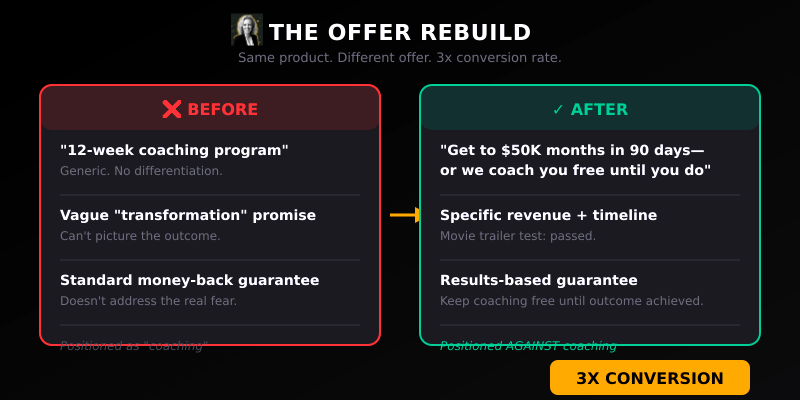
Different offer.
Conversion rate tripled.
Why This Matters More Than Ever (The Guru Problem)
Let me pause here and address the elephant wearing a “JUST HUSTLE” t-shirt in the room.
You know what I love about the coaching/course industry?
Nothing. I love nothing about it.
Okay, that’s not entirely true. I love the potential of it. The idea that someone with real expertise can package their knowledge and help people at scale? Beautiful.
What I don’t love is the army of bro-marketers who’ve turned “make an offer” into “make the most outrageous promise possible and figure out how to deliver it later.”
You’ve seen them:
“I went from $0 to $10M in 18 months and you can too!” (Conveniently leaving out the $500K in family money, the existing network, and the twelve failed businesses before this one.)
“My students are making $100K months!” (One student. Once. It was their best month ever and they’ve never repeated it. But technically not a lie!)
“This is the only system you’ll ever need!” (Until next year’s program launches with an entirely different system.)
The result? Everyone’s offer sounds the same. Everyone’s claiming ridiculous results. Everyone’s got testimonials from people you’ve never heard of making money amounts you can’t verify.
And the audience?
They’re exhausted. They’ve been burned. They’ve bought three programs that didn’t work. They’re sitting on your webinar thinking, “Okay, prove to me you’re different from the last five people who promised to change my life.”
That’s why offer differentiation matters more now than it ever has.
You’re not just competing against other offers. You’re competing against the scar tissue from every disappointment that came before you.
The Offer Audit
Before you touch your funnel again, answer these questions honestly.
Not the version of these answers you put on your sales page. The real answers. The ones you’d tell your best friend after a third glass of wine.
1. What specific, measurable outcome does my offer promise?
If your answer is vague — “get more clients,” “grow your business,” “feel better” — that’s your problem.
Specificity sells. Vagueness dies.
Test: Can someone read your promise and know exactly whether they achieved it? If there’s any ambiguity, rewrite it.
2. Why should they believe I can deliver it?
What proof do you have?
Case studies?
Your own results?
A methodology they can evaluate?
Third-party validation?
If you can’t prove it, you need to build proof before you scale. Period.
No amount of persuasion copy fixes a lack of evidence.
3. What’s the risk to them if it doesn’t work?
Time? Money? Both? Reputation? Opportunity cost?
How are you mitigating each one?
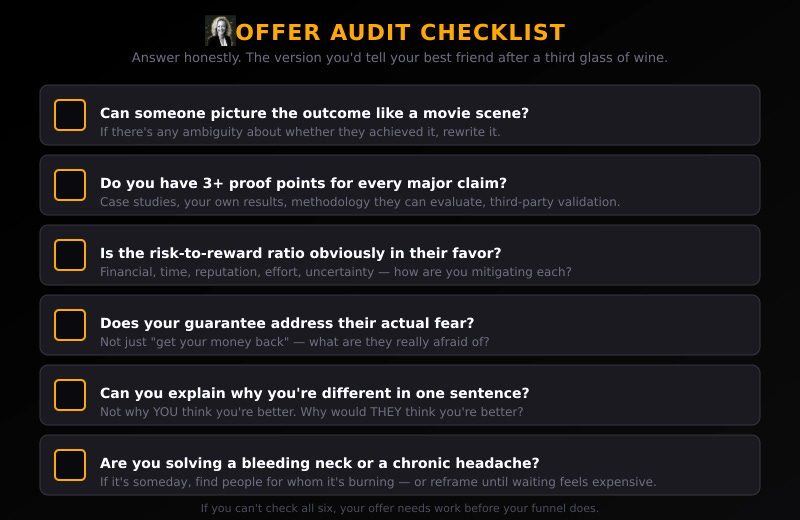
4. Why would they buy from me instead of [competitor]?
Not why you think you’re better. Why would they think you’re better?
If you can’t answer this clearly, neither can they.
5. How urgently do they need this solved?
Is this a burning problem or a someday problem?
If it’s someday, you need to either:
Find people for whom it’s burning, or
Reframe the consequence of inaction until waiting feels expensive
The Fix (It’s Uncomfortable)
Stop optimizing your funnel.
I know that hurts. You paid good money for that funnel. You’ve got heatmaps and everything.
But here’s what actually works:
Start talking to people who didn’t buy.
Not customers. Not fans. Not your email list who just needs “more nurturing.”
The people who saw your offer and walked away. They have the answers. You just have to be willing to hear things that are uncomfortable.
Call five of them this week.
Not to sell. Not to convince. Just to understand.
Ask them:
“What made you decide not to buy?” (Shut up and let them talk. The first answer isn’t the real answer.)
“What would have needed to be different?” (This is where the gold is.)
“Did you buy something else instead? Why?” (Painful to hear. Essential to know.)
“What’s still unsolved for you?” (The problem you’re trying to solve — did they find another solution, decide it wasn’t worth solving, or just give up?)
Their answers will tell you exactly what’s missing from your offer.
Then you fix the offer.
Then — and only then — you optimize the funnel.
The Real Funnel
Here’s the thing nobody talks about:
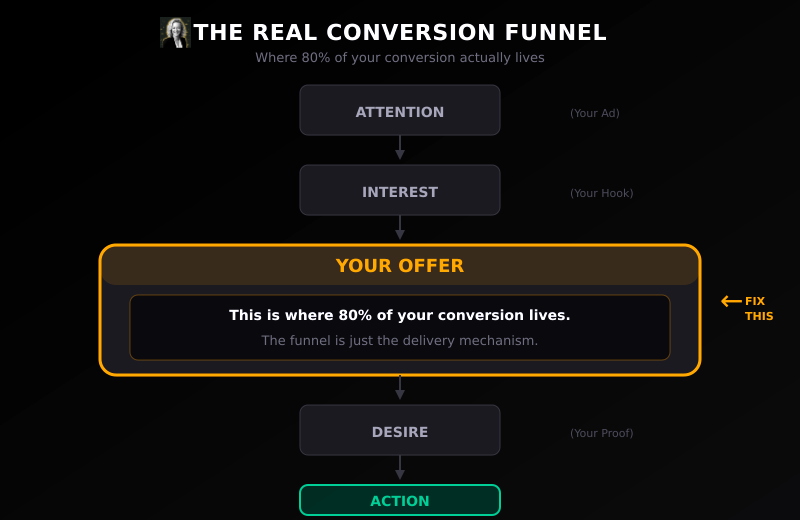
Notice that giant box in the middle?
That’s where 80% of your conversion lives.
The funnel is just the delivery mechanism. It’s the truck that brings the package. But if the package is empty, it doesn’t matter how fast the truck is.
Your funnel is probably fine. Your offer needs work.
Stop avoiding that conversation.
Want me to look at your offer? DM me “OFFER AUDIT” and I’ll tell you what’s actually broken.
No pitch. No upsell. Just the uncomfortable truth.
—The Angry Strategist
P.S. If you’re sitting there thinking, “But my offer IS specific and differentiated!” — then answer this:
Why didn’t the last 100 people who saw it buy?
If you don’t know the answer, you don’t know your offer.
Get on the phone. Ask the hard questions.
The data you need isn’t in your analytics dashboard. It’s in the minds of the people who clicked away.