
The Standing Meeting That Should Have Died Six Months Ago
A eulogy for the recurring invite that no one has the courage to kill

You know the one.
Tuesday at 2 pm. Or the Monday morning “sync.” Or the Friday “check-in” that somehow burns 45 minutes to accomplish what a three-line Slack message could handle in 90 seconds.
Here’s the thing about that meeting: it’s stealing from you. Every. Single. Week.
And you’re letting it.
The Crime Scene
It started with a purpose. A project launch. A new team. Someone said, “We should meet regularly to stay aligned,” and everyone nodded because nodding is easier than asking the obvious question:
“Do we though?”
That was eighteen months ago.
The project shipped. The team reshuffled. The original reason for existing evaporated like your enthusiasm every time that calendar reminder pops up.
But the meeting? Still breathing.
Shambling through your week like the undead. Consuming time. Producing nothing. Impossible to kill because no one wants to be the villain who suggests killing it.
Spoiler: Being the villain pays better.
How to Spot a Zombie Meeting
(So You Can Put It Out of Its Misery)
The first five minutes are people arriving late. Because even their subconscious knows this isn’t worth being on time for. Their gut figured it out before their calendar did.
The agenda hasn’t changed since the Obama administration. “Updates from each team.” Round-robin status reports that could’ve been a shared doc no one would read—because nothing in them requires reading urgently. Or ever.
Half the attendees have their cameras off. They’re not “disengaged.” They’ve correctly assessed that their attention isn’t required. They’re doing actual work while you drone on. Smart move, honestly.
Decisions never happen. Things get “discussed” and then “tabled for next week.” Where they’ll be discussed again. Forever. Because this meeting isn’t a decision-making body. It’s a support group for people afraid of email.
No one can explain why it exists. Ask anyone in the meeting what its purpose is. Watch them buffer like a 2008 YouTube video.
“It’s good to stay connected.” “It keeps everyone informed.”
Translation: “I have no idea, but canceling it feels scary.”
Why This Meeting Won’t Die
(The Uncomfortable Truth)
Killing meetings has social cost. Suggest ending a meeting and you risk looking like you don’t value “collaboration.” Or you’re “not a team player.” Or you think you’re too important.
So everyone suffers in silence.
Polite. Professional. Bleeding hours they’ll never get back.
Someone’s ego is attached to it. Someone created this meeting. It’s their baby. Suggesting it should die is suggesting they made a mistake.
So it lives on—a monument to one person’s ego and everyone else’s conflict avoidance.
Meetings feel like work. This is the darkest truth.
Sitting in a meeting looks productive. Your calendar is full. You’re “busy.” The meeting provides a socially acceptable way to fill time without producing anything.
Some people prefer the meeting. Because the alternative is actually having to do something.
Nobody does the math.
Let me do it for you:
8 people × 1 hour = 8 hours of company time
Average fully-loaded cost: $75/hour
Weekly cost: $600
Monthly cost: $2,400
Annual cost: $28,800
For a meeting where nothing happens.
You could hire a part-time employee for what you’re spending on this zombie.
Sleep on that.
How to Kill It
(Because Someone Has To)
If you own the meeting:
Just kill it.
Send this message:
“I’m canceling our recurring [meeting name]. It served its purpose when we were [original context], but I don’t think it’s adding value anymore. If you disagree, let me know.”
You’ll get zero pushback. People will be relieved.
You’ll be a hero. The person who gave everyone an hour back.
If you don’t own the meeting:
Ask the owner directly:
“I want to make sure I’m adding value here—what would we lose if I dropped off?”
Watch them struggle to answer.
If they can’t articulate it, suggest a trial:
“What if I skip the next two and we see if anything breaks?”
Nothing will break.
If you’re senior enough to do a purge:
Declare a meeting amnesty.
“We’re killing all recurring meetings. Each one has to re-justify its existence to get back on the calendar. If you can’t articulate what the meeting produces, it stays dead.”
You’ll reclaim hundreds of hours across your organization.
People will talk about it for years.
The Replacement
(Because Some Coordination Actually Matters)
Not every meeting needs to die. Some real-time conversation is necessary.
But here’s your filter:
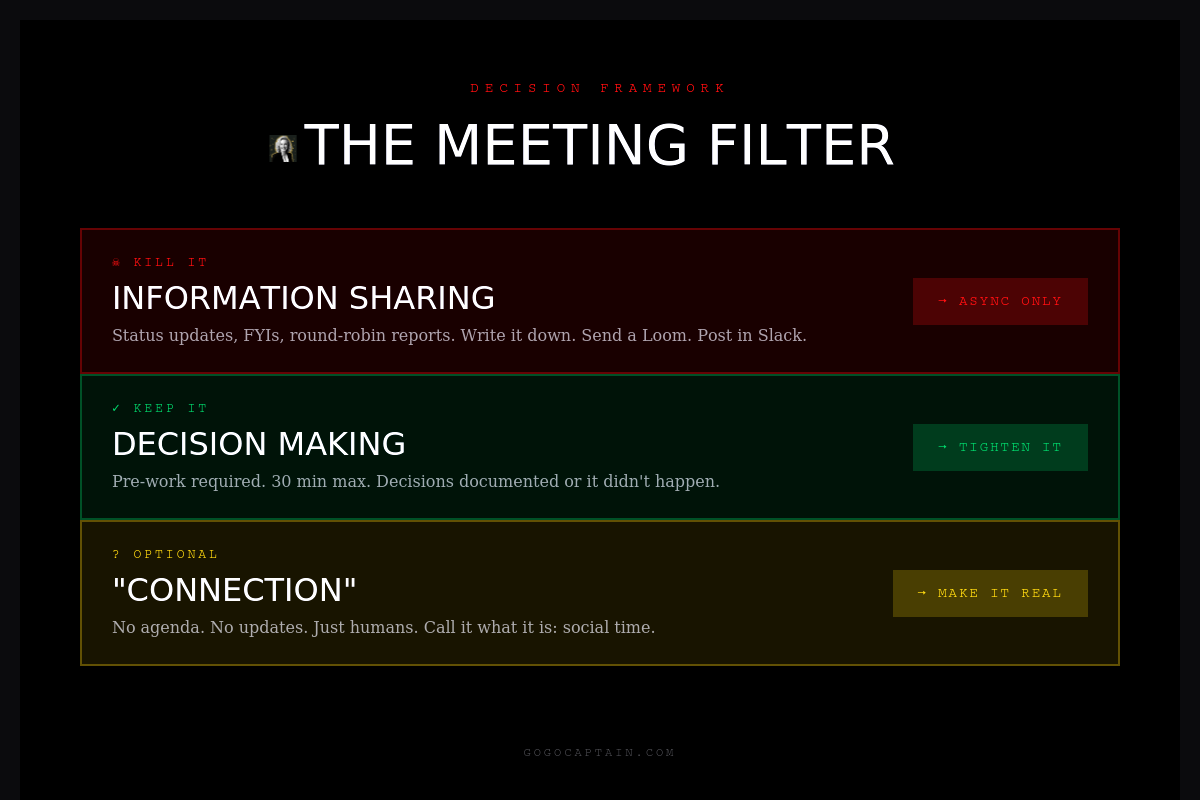
If the meeting is for information sharing → KILL IT. Write it down. Send a Loom. Post in a channel. People consume information faster when they’re not trapped in a conference room pretending to care.
If the meeting is for decision-making → KEEP IT, but tighten it.
Pre-work required
30 minutes max
Decisions documented or it didn’t happen
If the meeting is for “connection” → Make it optional. Make it real. No agenda. No updates. Just humans talking.
Call it what it is: social time.
Stop pretending watercooler chat is a deliverable.
Your Move
Pull up your calendar. Right now.
Find the meeting you thought of while reading this.
You know the one.
This week, decline the next occurrence.
Just decline it.
See what happens.
I promise you: nothing will happen.
No one will notice. The company will not collapse. You’ll just get an hour of your life back.
And if someone does notice?
Good.
Now you can have the conversation that should’ve happened eighteen months ago.
RIP to the meeting.
It served its purpose once.
Time to let it go.
Go! Go! Captain! is where marketing leaders come to build systems that scale without burning out themselves or their teams.
Want more? Subscribe at gogocaptain.com