
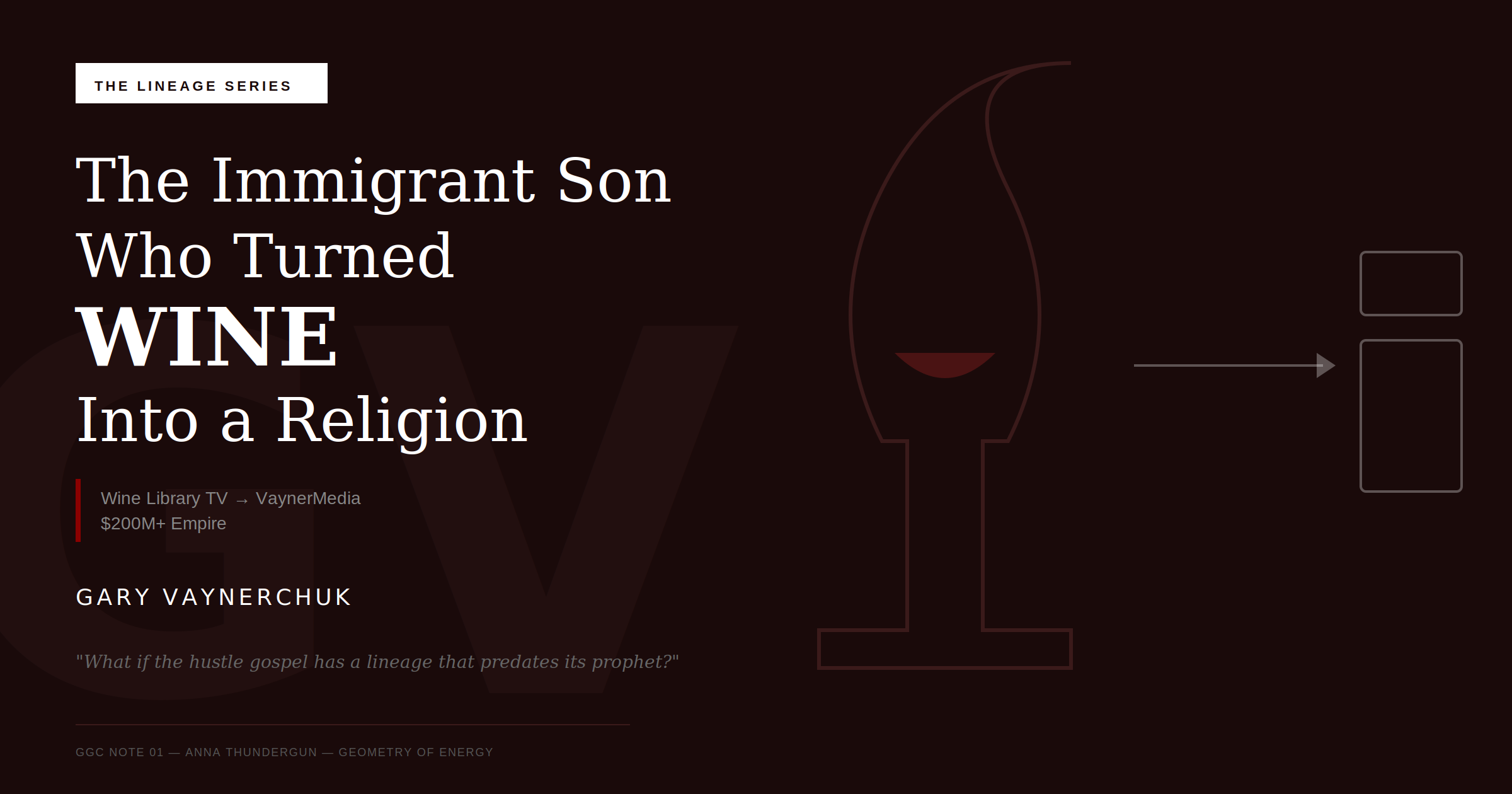
The Immigrant Son Who Turned Wine Into a Religion
Wine Library to VaynerMedia: What Gary Vaynerchuk actually built—and the principle underneath it all.

Gary Vaynerchuk family arrived in America as Soviet refugees in 1978.
Eight people. One studio apartment. Queens, New York.
His father got a job as a stock boy at a liquor store, saved every dime for years, and eventually bought the place.
This origin story doesn’t get enough attention.
The Inheritance
At fourteen, Gary was bagging ice in the family store for $2 an hour.
Not building a personal brand. Not “crushing it.”
Learning the business from the ground up.
The work ethic wasn’t invented for content. It was inherited from necessity. His father modeled the template before Gary had words for it. The discipline came first. The philosophy came later.
What He Actually Built
Here’s the timeline that matters:
Gary renamed the store from “Shopper’s Discount Liquors” to “Wine Library.” He launched an e-commerce site in the late 90s—one of the first for alcohol in the country. He started a YouTube show in 2006 called Wine Library TV and filmed over 1,000 episodes—consistent execution before anyone was watching.
Revenue went from $3-4 million to $60 million.
That’s not just motivation. That’s strategy plus execution over time with a new distribution channel. Gary saw something most people missed: the internet was going to change how products get sold.
He was early. And he was consistent.
The Walk Away
Then Gary did something that deserves more recognition.
He walked away.
No equity. No ownership. Left his father’s business and started over in his thirties with VaynerMedia.
He gave up a $60 million revenue stream because he believed he could build something of his own.
That takes conviction. It also takes a specific kind of confidence—the belief that what you’ve learned is more valuable than what you’ve accumulated. That you can do it again. That the principles transfer even when the context changes.
The Intellectual Lineage
The lineage is interesting, not diminishing.
Gary’s content philosophy is built upon Norman Vincent Peale’s The Power of Positive Thinking (1952), Dale Carnegie’s How to Win Friends and Influence People (1936), and the American immigrant success narrative that his father embodied.
His father modeled the template. Gary translated it for the internet age.
The “document, don’t create” philosophy was genuinely innovative.
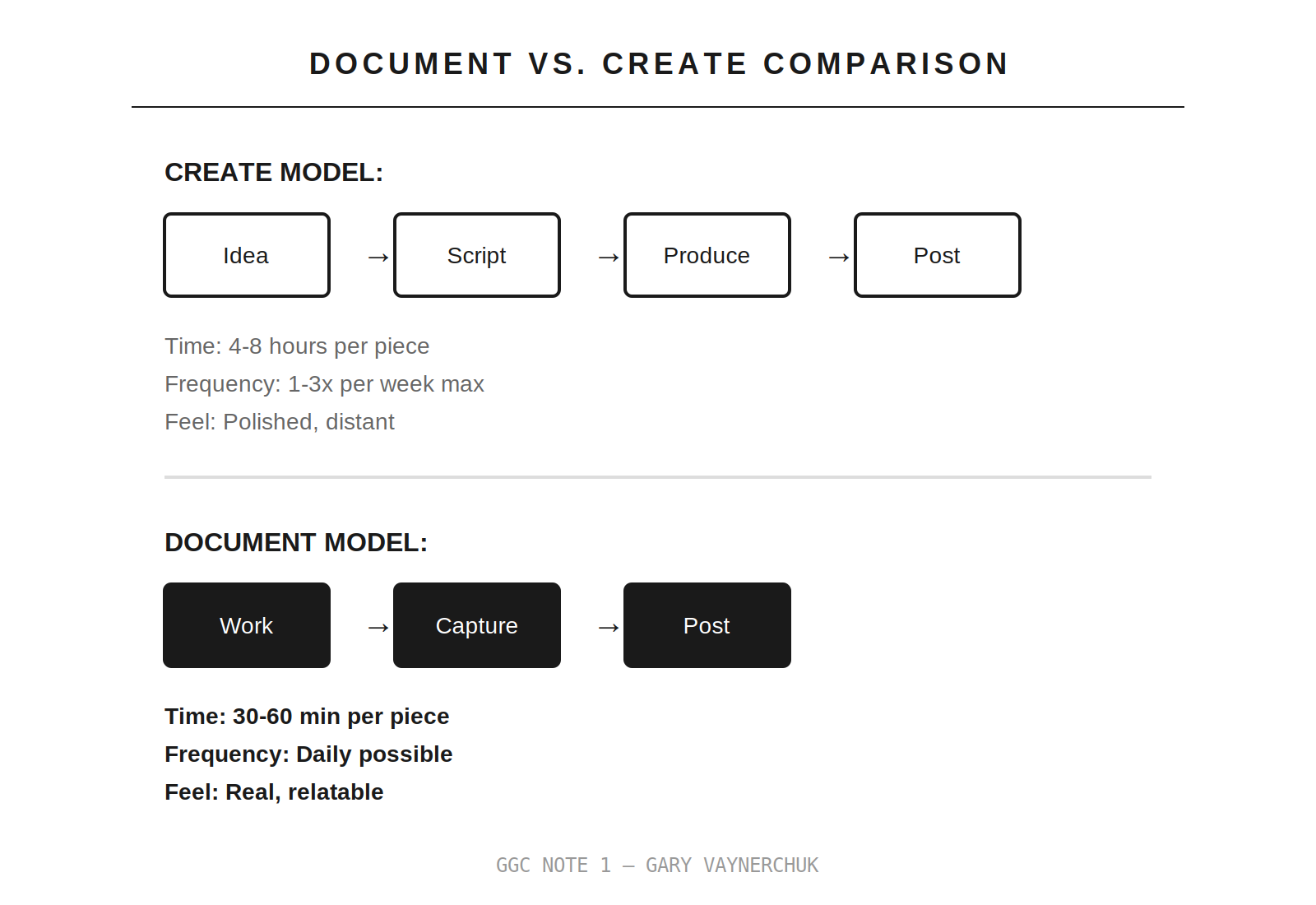
Reality television had explored authenticity as content. Gary applied it to business. Show the work. Show the mess. Let people feel like they’re alongside you.
This changed how entrepreneurs think about content.
The Evolution
Here’s what I respect most about Gary Vaynerchuk :)
He’s evolved publicly.
He’s admitted concerns about his own intensity. He’s softened his stance on hustle. Started emphasizing self-awareness, happiness, and knowing yourself.
He’s learning in public. That’s rare for someone at his level.
The challenge with any influential message is that it mutates as it spreads. The meme version of Gary—” hustle harder, sleep less, outwork everyone”—travels without the nuance he’s added over the years.
This isn’t Gary’s fault. It’s the nature of ideas in systems.
The Actual Edge
Gary’s real advantages:
Immigrant work ethic (genuine, inherited) Dear………
Early adoption of platforms (strategic, not lucky)
Willingness to create volume (disciplined, not manic)
Authentic personality (irreplicable)
The hustle was real. The platform timing was smart. The combination was powerful.
The Question Worth Asking
Gary built an empire by treating attention like currency and consistency like compound interest.
What would it look like to apply that same discipline to different areas?
Not just output—but recovery. Not just creation—but reflection.
Gary Vaynerchuk synthesized immigrant work ethic, early YouTube distribution, reality TV authenticity principles, and the Carnegie/Peale positive thinking tradition into something new for the internet age.
The synthesis is where the value lives.
The Invitation
Gary’s model works for Gary.
Your version might look different.
The principle—consistent action on emerging platforms—transfers. The specific application is yours to discover.
What are you accumulating? And where are you investing it?
The Principle Underneath
Here’s what most people miss when they study Gary’s story:
They see the output. The 1,000 episodes. The $60 million. The media empire. They think the lesson is more—more content, more hustle, more volume.
But Gary’s father understood something deeper.
He didn’t just work. He accumulated. He stored energy in the form of savings until he had enough to deploy strategically. The purchase of that liquor store wasn’t an impulse. It was years of patience converted into a single decisive action.
The geometry of sustainable energy isn’t linear. It’s cyclical.
Accumulation precedes sustainable expenditure. Before you can spend, you have to store. Before you can deploy, you have to accumulate.
Most people reverse this. They deploy before they’ve accumulated. They spend energy they haven’t stored. And they wonder why they’re exhausted three months into their “consistency.”
Go Deeper: GGC Strategy Note 01
This article covers what Gary built and where his ideas came from.
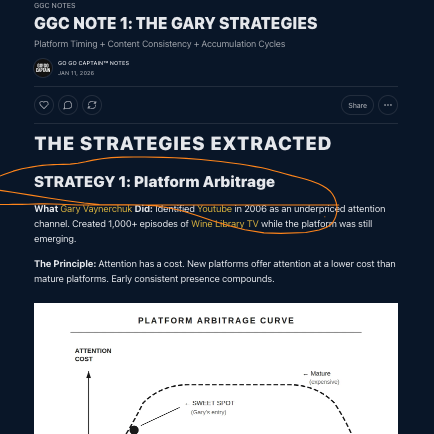
The GGC Strategy Note breaks down the how—the operational mechanics you can actually apply:
→ Platform Arbitrage Timing: How to identify the attention gap before everyone else arrives. The window between “too early” and “too late” where effort converts to outsized returns.
→ Document vs. Create: The Real Math Why documenting takes 30-60 minutes while creating takes 4-8 hours—and how this changes your content economics entirely.
→ The Accumulation Cycle The sustainable energy loop that Gary’s father modeled: Accumulate → Store → Deploy → Recover. The rhythm that makes consistency actually sustainable.
The thread gives you the story. The strategy note gives you the system.
GO! GO! CAPTAIN REMINDER
Energy operates in cycles, not lines.
Gary’s father saved for years before he could buy. The accumulation preceded the expenditure.
This is the principle most people miss when they study success stories. They see the deployment—the big move, the viral moment, the empire—without seeing the accumulation phase that made it possible.
The question isn’t “how hard can I push?”
The question is “what am I building reserves for?”
Sustainable output requires sustainable input. The geometry is cyclical. The captains who last are the ones who understand the rhythm.
Accumulate. Store. Deploy. Recover. Repeat.
This is the first installment of The Lineage Series—examining the intellectual roots and operational principles behind influential figures. Not to diminish. To understand. And to build something of your own.
Next in the series: Tony Robbins—The Physics of State Change
[Read GGC Strategy Note 01: Platform Arbitrage, Document vs. Create, and the Accumulation Cycle →]
P.S. — Links to Norman Vincent Peale's and Dale Carnegie's books are affiliate links. Same price for you, small commission for me. Transparency matters.
P.P.S. — Speaking of platform arbitrage and organic reach: I put these principles into practice, producing The Best Marketing Event Ever in London with Gary Vee. Sold out York Hall with zero ad spend. Here's how → [LINK]
Who Is Go! Go! Captain?

Go Go Captain™ Notes is where marketing leaders come to build systems that scale without burning out themselves or their teams. It’s the brand behind Digital Gardening — sustainable growth methodologies that replace hustle culture with strategic rhythm. Think of it as the antidote to every “10x your revenue” bro who left you exhausted and broke.
Who Is Anna Thundergun?
Anna Thundergun is the strategist behind Go! Go! Captain — a campaign architect and creative director who’s managed $30-50M in monthly ad spend across brands like Tony Robbins, Dean Graziosi, and MrBeast. She’s spent 15+ years in direct response marketing turning complex compliance challenges into competitive advantages and building funnels that scale without triggering platform bans.
She also writes as The Angry Strategist — because sometimes the industry needs someone to say what everyone’s thinking but nobody’s saying out loud.
Want help building a compliant funnel that actually converts? Let’s talk. 📧 [email protected]