

Proximity Is a Powerplay
Why the person next to the CEO gets promoted—and what to do about it

Power doesn’t sit in a bank account. It doesn’t live in a corner office.
It breathes in the space between people.
It’s who gets to whisper in whose ear. Who sits at the head of the table. Who slides past the velvet rope while everyone else waits in the parking lot.
We’ve been sold a myth: that power is about merit, mastery, and money. That if you’re good enough, you’ll rise.
But the research tells a different story.
Power is often geographic. It’s where you’re standing and who you’re standing next to.
That’s the oldest powerplay on earth. And after nearly a decade inside the machine—behind the curtain of the coaching industry’s biggest launches—I watched it play out in real time. I saw how it works, who it works for, and what it costs those who never learn the game.
The Science of Standing Close
Let’s get clinical for a second.
The Halo Effect is real and measurable. When you’re near someone perceived as great, people assume some of that greatness rubs off on you. This isn’t folklore—it’s documented psychology. Robert Cialdini’s research on “basking in reflected glory” shows we instinctively elevate those tied to winners. That’s why sports fans say “we won” when they personally contributed nothing to the score.
Robin Dunbar’s Number (the cognitive limit of about 150 meaningful relationships) shrinks dramatically at the top. If you’re in someone’s inner five, your influence skyrockets—not because you’re smarter, but because you’re closer. The CEO doesn’t have bandwidth for 150 trusted advisors. They have bandwidth for maybe five.
Ronald Burt’s Structural Holes Research at the University of Chicago is where it gets interesting. Burt found that senior managers whose networks bridged “structural holes” (gaps between disconnected groups) were promoted earlier and paid more. His research across high-tech electronics firms showed that the network structure—who you connect, not just who you know—is a significant predictor of career success.
Here’s the kicker: people who span gaps between groups don’t just advance faster. They generate better ideas. Burt’s research showed they have an “information arbitrage” advantage—they see things others miss because they’re positioned at the intersection.
The proximity-career link is longitudinal, too. Wolff and Moser’s three-year study on networking behaviors found that networking is related to both concurrent salary and salary growth rate over time. It’s not a one-time bump—it compounds.
The Business of Selling Access
If you’ve ever paid for a “VIP ticket,” you’ve already bought into the game.
Let me show you the pricing structure of proximity:
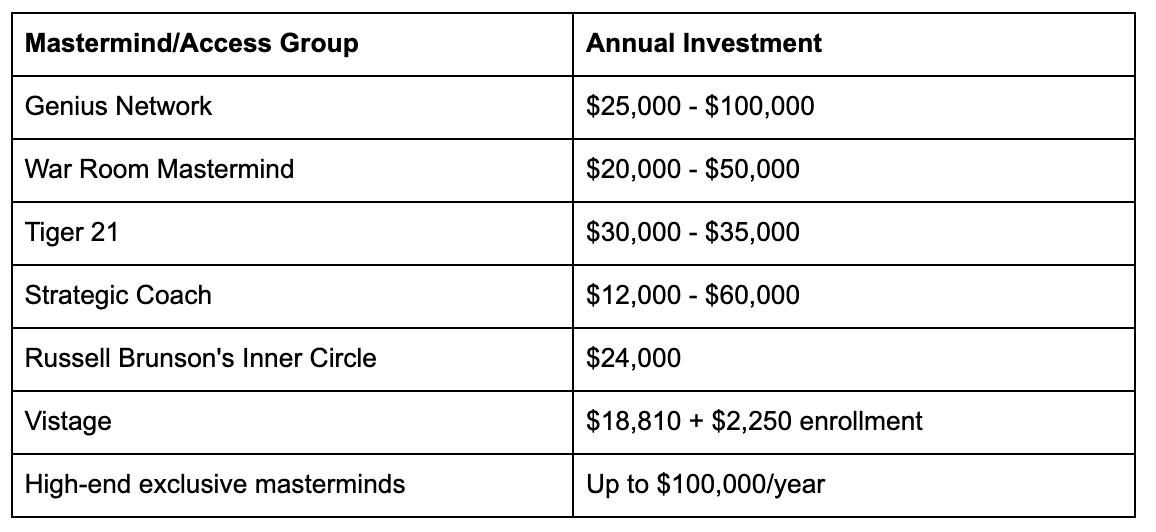
These aren’t tuition fees for education. They’re access fees. The information in most masterminds is available for free online. What you’re paying for is proximity to people who’ve already made it and proximity to others who are willing to pay that much to be in the room.
Napoleon Hill coined the “mastermind” concept in Think and Grow Rich after studying wealthy individuals and realizing they kept intentional company with other wealthy people. The insight: your personality is the average of the five people you associate with most.
But here’s what Napoleon Hill didn’t write about: the economics of manufactured scarcity.
When knowledge becomes commoditized (Google has it all), the scarce resource becomes access. And access can be priced at whatever the market will bear.
The 26% You’re Probably Ignoring
Research from the Center for Talent Innovation found something leaders rarely discuss openly:
Executive presence accounts for 26% of what it takes to get promoted to leadership positions.
Not performance. Not results. Presence.
That’s over a quarter of the promotion equation that has nothing to do with how good you are at your job.
A Gartner survey of CIOs ranked executive presence as the #2 desired leadership characteristic. And 89% of CEOs and communications executives believe leadership presence contributes to getting ahead—while 78% believe reduced presence is an active impediment to career advancement.
What is executive presence? Three components:
Gravitas (67% of senior leaders say this is the most important factor)—the ability to stay calm under pressure, maintain credibility, radiate confidence
Communication—how you articulate ideas and influence others
Appearance—how you show up, grooming, intentionality
Notice what’s not on that list: technical competence. Strategic thinking. Results.
Those are assumed at senior levels. Differentiation comes from presence.
And presence is often manufactured through proximity.
The Gender Gap in Proximity ROI
Here’s where the data gets uncomfortable.
Burt’s research on the “Gender of Social Capital” found something troubling: the entrepreneurial networks linked to early promotion for senior men do not work the same way for women.
Women in his studies who had the same structural position—the same network advantages—didn’t see the same returns. The promotional benefits of spanning structural holes were significantly diminished.
A study in the Journal of Organizational Behavior found that women receive less return on their investments across the board—education, work experience, training opportunities, and supportive relationships were all shown to be more beneficial for the career progression of men than women.
This isn’t a commentary on merit. It’s a commentary on systems.
Proximity is a powerplay. But the game isn’t played on a level field.
The Career Trap Nobody Talks About
Sociologist Erving Goffman wrote about this in The Presentation of Self in Everyday Life: we’re all performing. And when you get too close to power, you risk becoming part of someone else’s show.
Not the author of your own.
I lived this. Nearly a decade as the campaign architect behind some of the biggest launches in the coaching industry. Millions of leads. Hundreds of millions in revenue. My fingerprints on everything—my name on nothing.
That’s the career trap: confusing access with advancement.
Being “in the room” feels like influence. But clapping from the mezzanine is still clapping from the seats.
Three diagnostic questions:
Are you close because you’re chosen—or because you’re being used?
Does this proximity multiply your influence—or shrink it?
If the proximity disappeared tomorrow, would your power still stand?
If the answer to that last one is no, you’re not gaining power. You’re subsidizing someone else’s.
How to Play It Without Losing Yourself
The research points to a few strategies that actually work:
1. Shift from proximity to presence.
Anyone can hover near power. Few cultivate the kind of grounded presence that creates its own gravity.
The 26% executive presence factor isn’t about being near power.
It’s about projecting it yourself.
Stop chasing rooms. Become someone rooms form around.
2. Build structural holes, not dense networks.
Burt’s research is clear: it’s not about having the most connections. It’s about bridging disconnected groups.
The managers who got promoted fastest weren’t the ones with the biggest networks. They were the ones whose networks spanned different silos, functions, and industries.
Don’t just collect contacts. Connect worlds.
3. Protect your inner five.
Dunbar’s research reminds us: influence is limited by attention. Robin Dunbar found that our closest five relationships carry disproportionate weight.
Who you let into your five matters more than who you chase in theirs.
Audit your inner circle. Are they pulling you up or holding you in place?
4. Use proximity as a season, not a lifestyle.
The research on networking shows that using contacts in year one drives immediate promotions, while building and maintaining contacts drives advancement in year two and beyond.
Translation: get close, learn fast, then build your own platform.
Proximity is a catalyst, not a destination. Absorb the knowledge, the insight, the network—then stop orbiting and start building.
The Real Flex
Here’s what most people miss👇
The people you’re scrambling to sit next to? Many of them are just as insecure, just as scrambling, just as human as you.
They just learned the proximity game earlier.
Sociological research confirms that structural position—not inherent talent—drives much of career success. That’s uncomfortable. But it’s also liberating.
Because if success is structural, the structure can be hacked.
If you don’t understand how proximity works, you’ll spend your career clapping from the cheap seats while someone else cashes in on your backstage pass.
But if you learn to see it, name it, and use it strategically—
Proximity stops being a leash.
It becomes a lever.
Because the real powerplay isn’t sitting next to power.
It’s becoming the person everyone else wants to sit next to.
The Research That Backs This Up
For the skeptics and the strategists who want to go deeper:
Robert Cialdini, Influence — The psychology of association and “basking in reflected glory”
Robin Dunbar — Social connection limits and the 150-relationship threshold
Ronald Burt, Structural Holes (Harvard University Press) — Network structure as competitive advantage
Wolff & Moser (2009) — Longitudinal study on networking and career success
Erving Goffman, The Presentation of Self in Everyday Life — Performance and identity
Center for Talent Innovation / Coqual — Executive presence research showing the 26% promotion factor
Forret & Dougherty (2004) — Networking behaviors and career outcomes
Podolny & Baron (1997) — Social networks and mobility in the workplace
This is what I’ve learned from watching the game from inside the machine. The question isn’t whether proximity matters. It does. The question is: will you keep renting access from someone else’s platform—or will you build one of your own?
Anna Thundergun is the founder of Go! Go! Captain and spent nearly a decade as the campaign architect behind $B+ in revenue for clients including Tony Robbins, Dean Graziosi, and here. She now writes about sustainable leadership, human-centered marketing, and building systems that don’t burn you out.
Subscribe for more at Go! Go! Captain.
Want the full backstory? [See who I’ve worked with on LinkedIn.]