
How We Turned a 60-Year-Old Assessment Into a Lead Generation Machine
A Coaching Program Case Study: Significant CPL Reduction, Rapid Launch, and a Framework You Can Actually Steal.

(And no, it wasn’t magic. It was methodology.)
Go Go Captain™ Notes — THE ANGRY STRATEGIST
Here’s a fun question nobody asks in marketing meetings:
What do you do when your lead magnet has existed since the 1960s?
The Wheel of Life. You’ve seen it. You’ve probably taken it. An 8-spoke circle where you rate your satisfaction across career, money, health, relationships, romance, personal growth, fun, and physical environment.
Paul J. Meyer created it. Coaches have been using it ever since. It’s been deployed in therapy sessions, corporate retreats, and every personal development program that takes itself even slightly seriously.
So when I walked into a major coaching lead gen campaign, the brief wasn’t “create something new.” It was “make something ancient perform like it was invented yesterday.”
Spoiler: We did. Let me show you how.
The Problem Nobody Wanted to Name
When I joined this campaign, the coaching program was running lead generation the way most coaching programs do: landing page, promise of transformation, form, hope.
The Wheel of Life assessment existed. People knew it. But it was being used like a participation trophy—not a conversion tool.
Here’s what the funnel looked like before:
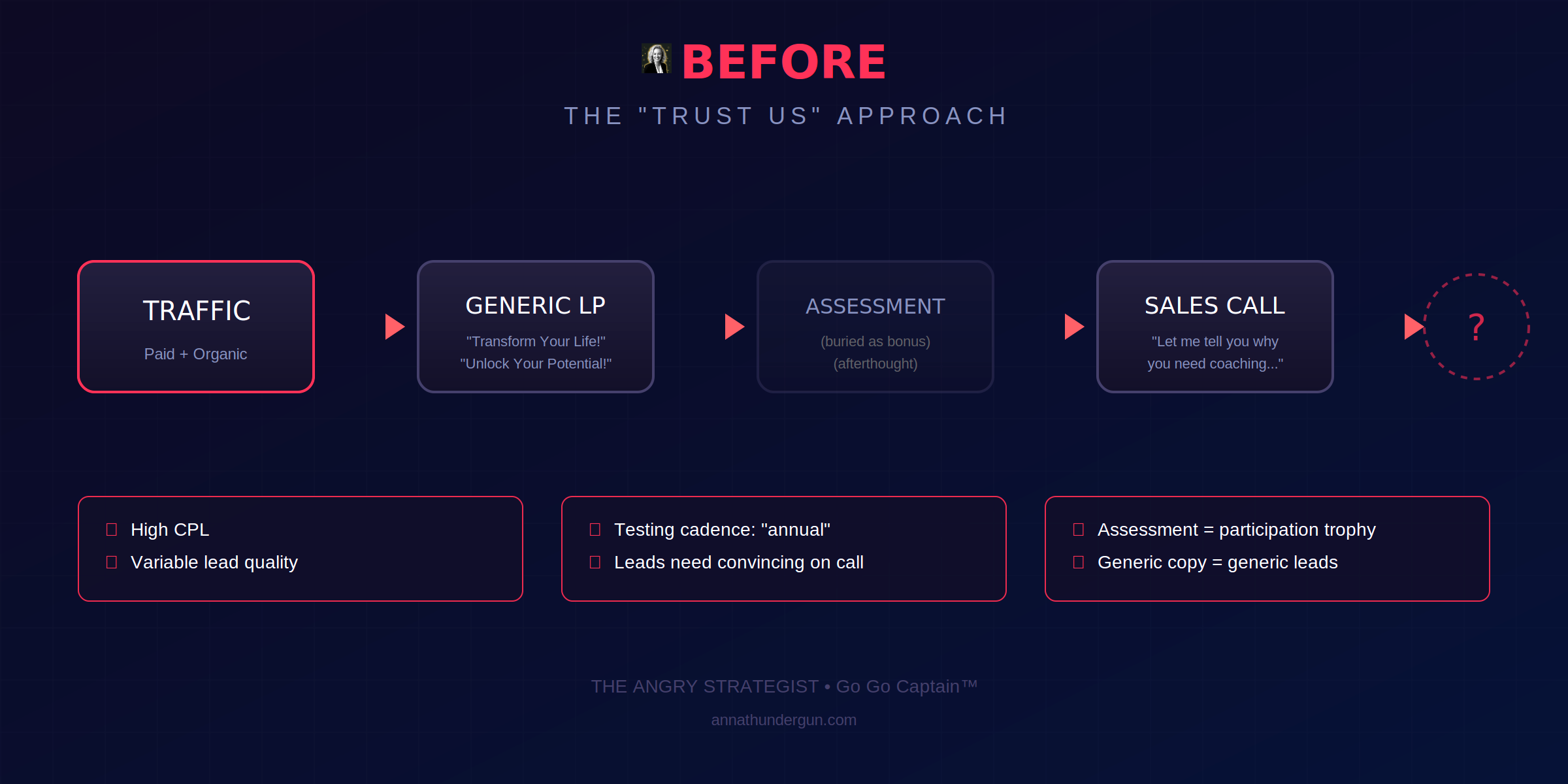
BEFORE: The “Trust Us” Approach
Traffic → Generic LP → Assessment as Afterthought → Sales Call → Hope
CPL was higher than leadership wanted. Lead quality was... variable. And the testing cadence? Let’s call it “annual” and be generous.
The fundamental mistake wasn’t the creative. It wasn’t the targeting. It wasn’t even the offer.
It was treating the Wheel of Life like a giveaway instead of a diagnostic.
The Insight That Changed Everything
Here’s what most marketers miss about lead magnets:
A lead magnet isn’t a gift. It’s a mirror.
The best lead magnets don’t just give people information. They show people themselves—and the gap between where they are and where they want to be.
The Wheel of Life already did this. It was literally designed to create self-awareness through contrast. Eight spokes. Eight scores. One visual that immediately reveals imbalance.
The problem? Nobody was letting it do its job.
The old approach buried the assessment behind generic copy. “Transform your life!” “Unlock your potential!” Words that mean nothing because they promise everything.
We flipped it.
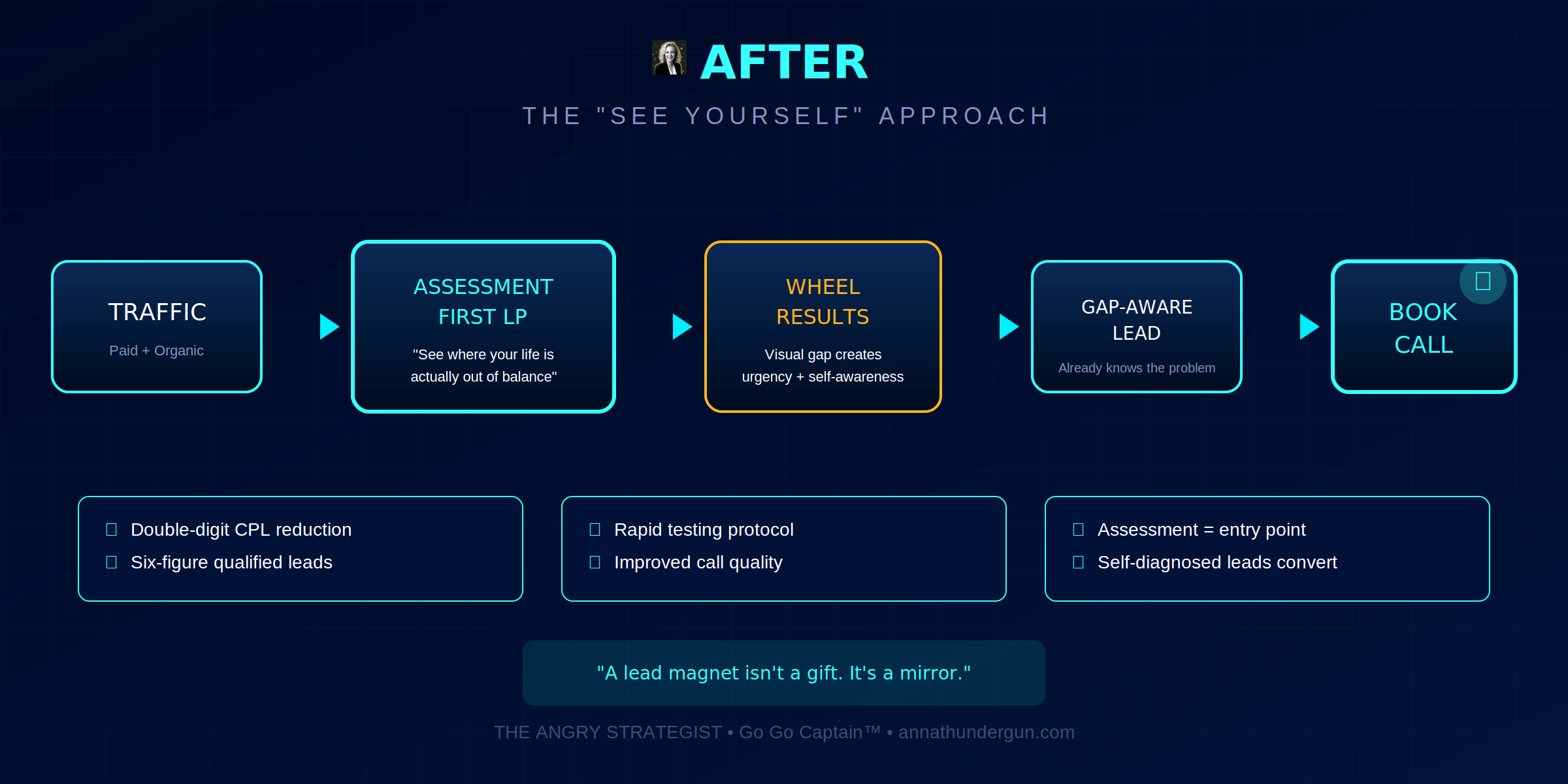
AFTER: The “See Yourself” Approach
Traffic → Assessment-First LP → Personalized Results → Gap-Aware Lead → Sales Call → Conversion
The assessment became the entry point, not the afterthought.
The Rapid Testing Framework
Now here’s where it gets tactical.
Most coaching funnels test like they’re afraid of their own data. One headline test per month. Maybe a new image if someone’s feeling bold. Results are reviewed quarterly if the CEO remembers to ask.
I introduced what I call the Pulse Testing Protocol. Not because it’s trademarked (it’s not), but because it treats campaigns like living systems with vital signs you check constantly.
Traditional Testing:
1-2 tests per month
Results reviewed sporadically
Decisions made on gut feelings
Weeks between insight and action
Pulse Testing Protocol:
Multiple tests per week minimum
Daily performance monitoring
Decisions made on data
48-72 hours from insight to iteration
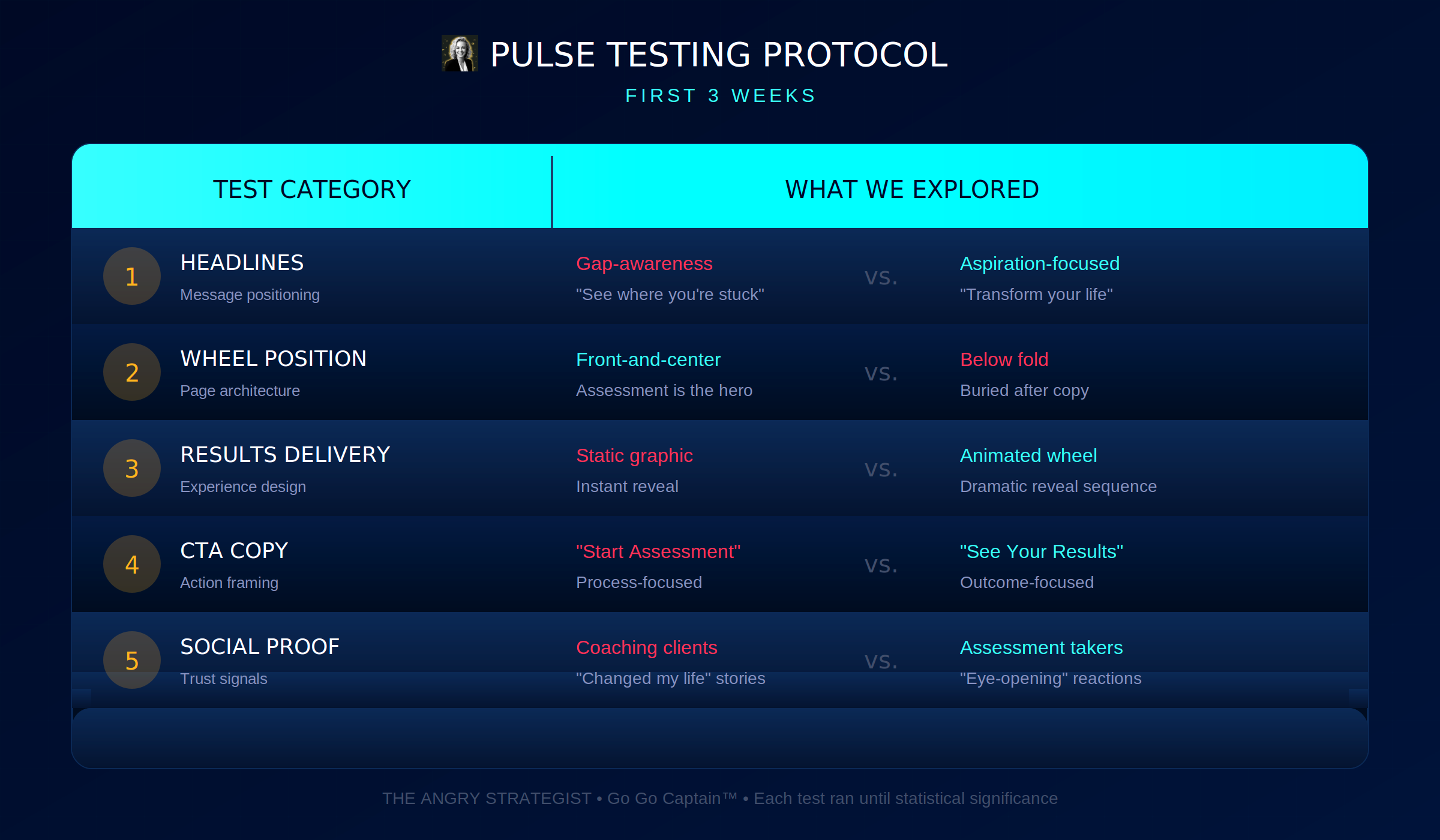
Here’s what we tested in the first few weeks
The Numbers (Directionally)
I’m not going to give you exact figures because some things stay internal.
But here’s what I can tell you:
Lead volume: Six figures. Qualified.
CPL improvement: Double-digit percentage reduction
Launch timeline: Weeks, not months
Platforms: Multi-channel deployment across paid social
But here’s the number that matters most and never makes the case study:
Call quality improved meaningfully.
Why? Because people who take an assessment and see their own imbalance don’t need to be convinced there’s a problem. They just saw it. On a wheel. That they filled out themselves.
The sales call isn’t “let me tell you why you need coaching.” It’s “you already know where you’re stuck—let’s talk about how to move.”
What Actually Drives CPL Reduction
Let me kill a myth while we’re here.
Most marketers think CPL reduction comes from:
Better targeting
Cheaper placements
Shorter forms
More aggressive bidding
Those help. But they’re optimization, not transformation.
Real CPL reduction comes from increasing the perceived value of the action you’re asking someone to take.
A form that says “Download our guide” is worth... nothing. It’s a transaction. An exchange. I give you my email, you give me a PDF I’ll never read.
An assessment that says “See where your life is actually out of balance” is worth something. It’s a service. A mirror. Something the prospect wants for themselves, regardless of what happens next.
When the lead magnet has intrinsic value, people don’t need to be bribed into taking it. They want to.
That’s how you get CPL reduction that holds—instead of the kind that collapses the moment you scale.
The Diagram: Before vs. After Funnel Architecture
BEFORE:
AFTER:
The difference isn’t complexity. It’s sequence. And intention.
The Lesson for Your Campaigns
You probably don’t have the Wheel of Life. But you have something.
Every coaching program, every course creator, every service business has some version of a diagnostic that reveals the gap between where someone is and where they want to be.
Most of them are buried. Hidden behind opt-ins. Treated as afterthoughts instead of architectures.
Ask yourself:
What’s the mirror you could hold up to your prospects?
How could you let them diagnose themselves before you prescribe?
Where are you selling when you should be revealing?
The best lead magnets don’t convince. They clarify.
The best funnels don’t push. They illuminate.
The best campaigns don’t acquire leads. They attract people who already know they have a problem and just need someone to help them see it.
The Uncomfortable Truth About “Revolutionizing” Anything
I need to come clean about something.
The headline of this case study says we “turned it into a machine.” That’s the language we use in portfolios because it sounds impressive. It makes the work seem bigger.
But here’s what actually happened: I didn’t revolutionize anything. I paid attention to what was already working and removed the things that were getting in its way.
The Wheel of Life didn’t need reinvention. It needed respect.
The assessment didn’t need gamification. It needed positioning.
The funnel didn’t need more steps. It needed fewer assumptions.
The “revolution” was subtraction, not addition. Clarity, not complexity.
That’s usually how the best campaigns work. Not by inventing something new, but by getting out of the way of something that was always true.
One More Thing
If you’ve read this far, you’re either:
a) A marketer who wants to steal this framework (do it, I don’t care)
b) Someone who worked on this campaign and is fact-checking me (hi)
c) A person genuinely interested in how strategy works at scale
For the third group: this is what I do. Not just the tactics—the thinking behind them.
The rapid testing. The positioning shifts. The uncomfortable conversations about why your current approach isn’t working.
If that sounds useful, we should probably talk.
Anna Thundergun is the strategist behind significant attributed revenue and the creator of the Digital Gardening methodology. She writes about marketing strategy, leadership systems, and why most marketing advice is garbage.
Subscribe to Go Go Captain™ Notes for more frameworks you can actually use.