
How We Built a Million-Person Launch in a Holiday Window
(And What the $50K Studio Shoot Taught Us About What Actually Converts) THE ANGRY STRATEGIST — CASE STUDY January 2026

THE ANGRY STRATEGIST — CASE STUDY
January 2026

The Brief (And Why Most Teams Would’ve Choked)
Here’s what landed on the desk⤵️
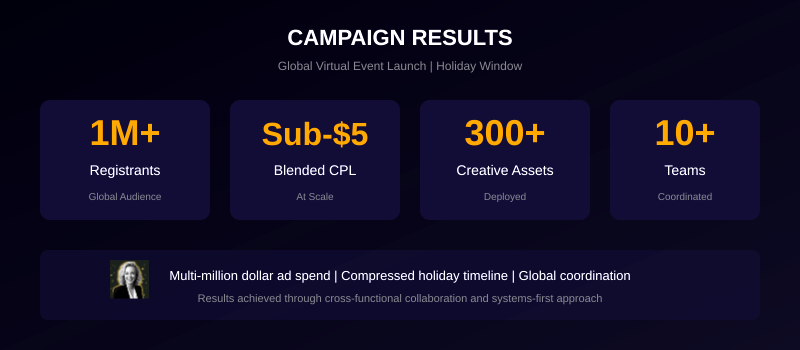
Launch a global virtual event designed to activate millions. Do it during the holiday window when attention is scattered, and competition is brutal. Coordinate 10+ departments. Manage a multi-million dollar paid media budget. Build the entire acquisition engine from scratch.
Timeline? Compressed.
Margin for error? The kind where you laugh nervously and check Slack at 2 am.
Still with me? Good. Because here’s where it gets interesting.
My Role (The Unsexy Version)
My title was “Senior Campaign Manager.”
Which is corporate speak for: I helped build the system, run the system, and fix the system when it caught fire—often simultaneously, usually without sleep, occasionally while questioning my life choices.
Helped architect the acquisition engine. Funnel architecture. Messaging strategy. Testing frameworks. The stuff that looks boring in a deck but determines whether your CPL is $5 or $50.
Supported media optimization. Daily performance tracking. Real-time creative swaps. The kind of work where you’re refreshing dashboards at midnight because something just tanked and tomorrow’s spend is already committed.
Coordinated 300+ creative assets. Across paid, email, SMS, landing pages, and livestream promos. That’s not a typo. Three hundred. Each one needed approval, alignment, and deployment on a timeline that didn’t care about weekends…or my daughter’s traveling soccer tournaments.
Ran a multi-week flight plan across 10+ teams. Internal. External. Creative. Media buying. Sales. Content. Everyone rowing in the same direction—or at least not directly into each other.
The Breakthrough Nobody Expected
Pause for a second. When you’re running campaigns at this scale, there’s a moment where you realize something uncomfortable:
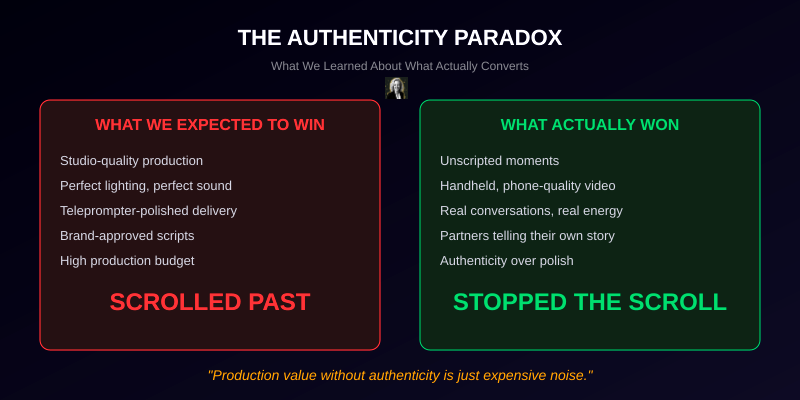
The polished content doesn’t convert.
I know. It should. You’ve got the production budget. The lighting is perfect. The talent looks presidential. Everything is on-brand. And the audience scrolls right past it as it owes them money.
You know what stopped the scroll?
Unscripted moments. Handheld. Shot on what looked like an iPhone. No teleprompter. No studio setup. Just a person talking to a camera like they were talking to a friend.
Partners telling the story their way. Not our script. Not our brand guidelines. Their words. Their energy. Their version of why this mattered.
The expensive studio shoot? Outperformed by a selfie video.
That’s the kind of lesson that costs six figures to learn. You’re welcome.
Why Does This Happen?
Here’s the principle underneath: Authenticity creates attention. Attention creates action.
Your audience has seen ten thousand polished ads today. Their brain has been trained to recognize “this is marketing” and filter it out before they’re consciously aware they’re doing it. It’s not malice. It’s survival. If they processed every ad they saw, they’d never get anything done.
But a person talking like a person? That registers differently.
It’s not that production value doesn’t matter. It’s that production value without authenticity is just expensive noise. Ask yourself: When was the last time a polished ad stopped YOUR scroll? Versus someone talking directly to the camera about something they clearly care about?
The System That Made Speed Possible
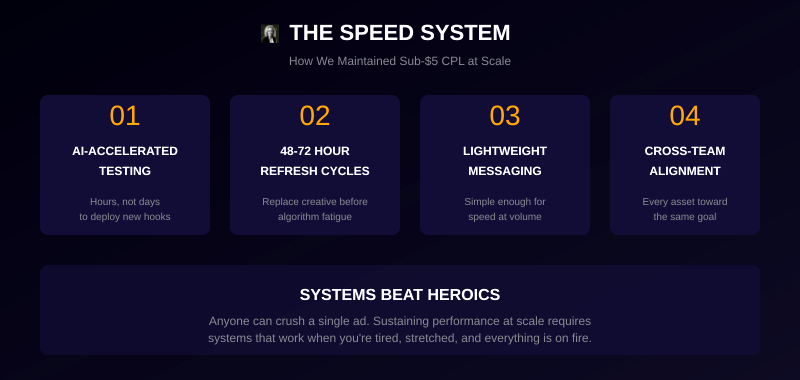
Here’s what actually drove results at scale:
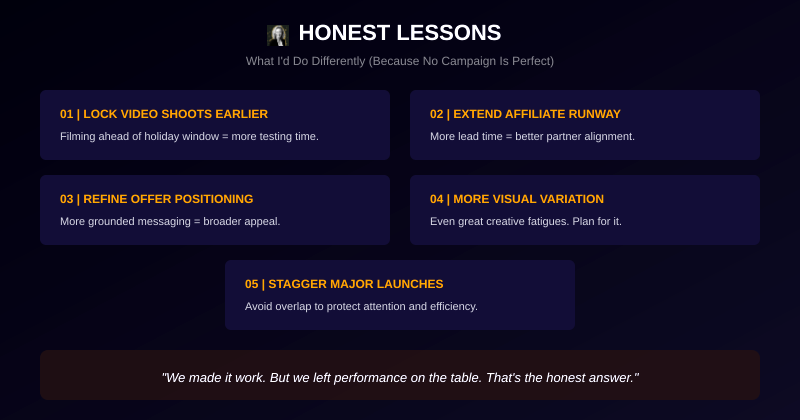
What I’d Do Differently (The Honest Part)
No campaign is perfect. Anyone who tells you theirs was is either lying or wasn’t close enough to see the fires. Here’s my honest assessment:
On Trust and Visionaries
Here’s something I don’t say enough: This campaign happened because leadership trusted the team to execute something ambitious on a timeline that would make most organizations tap out.
That’s not nothing.
The visionaries set the target: a global event that could actually change how people think about what’s possible for them. The team figured out how to make it real. Both parts matter. Vision without execution is a TED talk. Execution without vision is a hamster wheel.
I was fortunate to work with people who understood that the best results come from giving talented teams room to move fast and fix things in flight. Not every organization operates that way. The ones that do tend to build things worth talking about.
The Principle I Keep Coming Back To
Here’s what this campaign reinforced for me: Systems beat heroics.
Anyone can crush a single ad. Anyone can have a good week. But sustaining performance at scale across a compressed holiday timeline? That requires systems that work when you’re tired. Systems that work when the team is stretched. Systems that work when everything is on fire, and you need to make decisions faster than you can think.
The campaign succeeded because the architecture was right. The creative strategy was right. The operational rhythm was right. And because a lot of people showed up and did hard things when it mattered.
What I Actually Bring
If you’re building something at this scale and you need a strategist who can run the machine—not just draw the diagram—here’s what I bring:
Campaign strategy at scale. Concept to conversion. Strategy to execution. The part where the deck becomes a dashboard.
Direct response creative direction that sounds human. Because that’s what converts now. The polished-ad era is over. We just haven’t all gotten the memo yet.
Systems that transform strategy into action. And action into sustained momentum. Not one good week. Consistent performance.
Cross-functional alignment. Marketing, creative, product, sales—all rowing the same direction. It sounds obvious. It rarely happens. I’ve seen what it looks like when it does.
Want to Talk?
I’m happy to walk through methodology and frameworks if you’re tackling something comparable. The strategy only works if you execute it. And most people won’t.
This is how I’ve always worked: make it real, make it move, make it matter. The fancy titles came later.
Strategy without the bullshit.