
How a Quiz Funnel Drove Eight Figures in Sales for a Health E-Commerce Brand
The compliance playbook that scaled a weight loss supplement on Meta for a full year without a single ad rejection. THE ANGRY STRATEGIST — CASE STUDY January 2026

How a Quiz Funnel Drove Eight Figures in Sales for a Health E-Commerce Brand
The compliance playbook that scaled a weight loss supplement on Meta for a full year without a single ad rejection.
THE ANGRY STRATEGIST — CASE STUDY
January 2026
A note on attribution: This case study reflects a team effort—strategists, media buyers, copywriters, designers, and a client willing to trust the process. I’m sharing the strategic framework because the principles are what matter, not individual credit. The brand has been anonymized to respect confidentiality.
Let me tell you about one of the most elegant compliance strategies I’ve ever helped build.
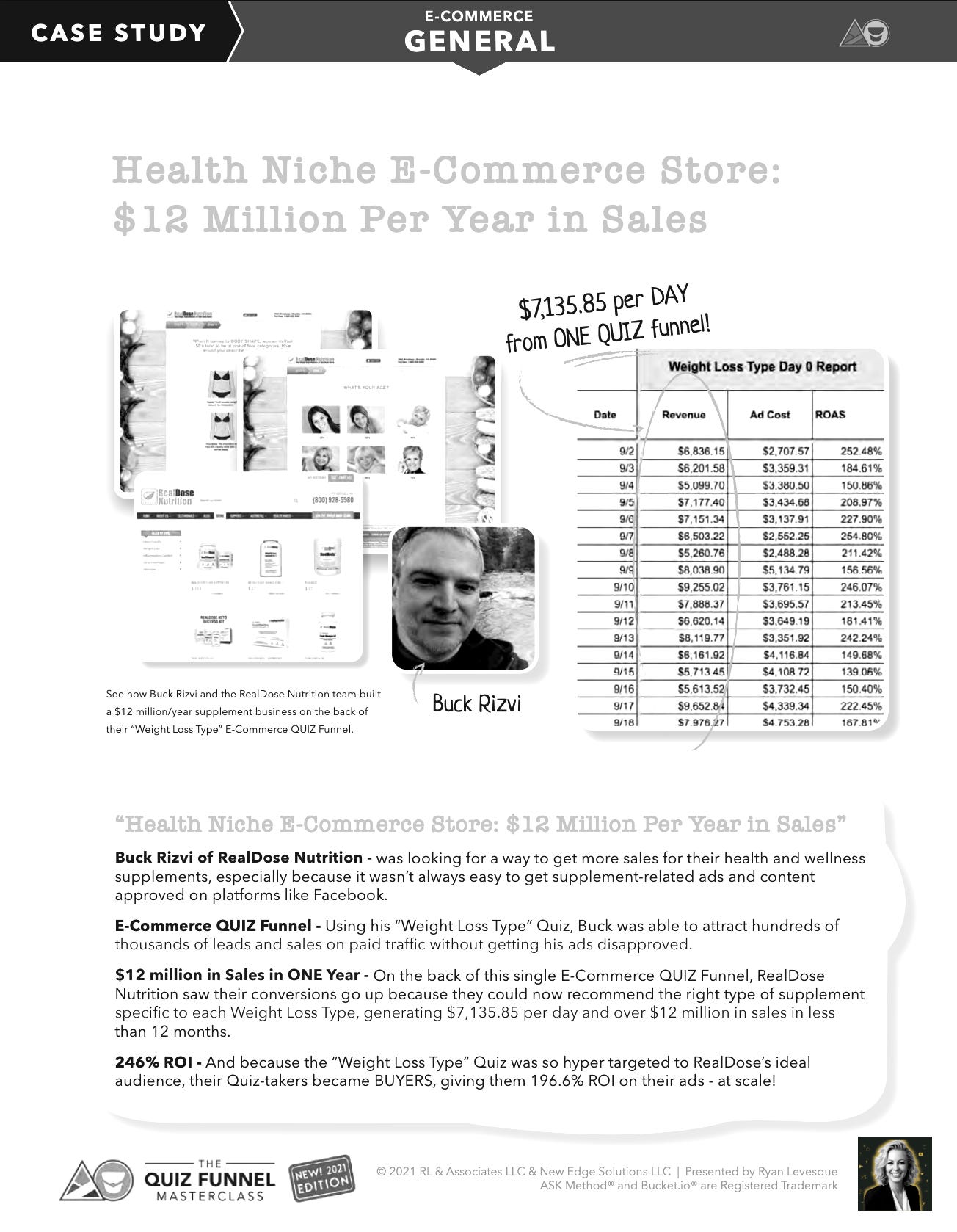
Eight figures in revenue over the campaign period. 200%+ ROI at peak performance. All while selling weight loss supplements on a platform that treats the words “lose weight” as if you’ve just tried to sell contraband to a kindergartner.
The brand was a science-backed nutrition company in the weight management space.
The challenge was simple: Scale profitably on Meta without getting banned.
The solution? A quiz funnel. But not the kind you’re imagining.
The Problem (And Why Most Health Brands Can’t Scale)
Here’s what most supplement brands do on Facebook: They run an ad that says “Lose weight fast!”—rejected. They try “Transform your body!”—flagged for negative self-perception. They pivot to “Feel better about yourself!”—account restricted. Eventually, they give up and blame “the algorithm.”
Meanwhile, the average e-commerce conversion rate sits at a miserable 2-4%, according to data from Dynamic Yield tracking 200M+ monthly users across 400+ brands. For health and supplements specifically? Even lower. Because the traffic you’re buying is cold, skeptical, and has been burned by every “miracle pill” promise since the ’90s.
So, how do you sell a weight loss supplement without triggering every compliance red flag Meta has? You stop selling. You start asking.
The Strategy: Education as a Trojan Horse
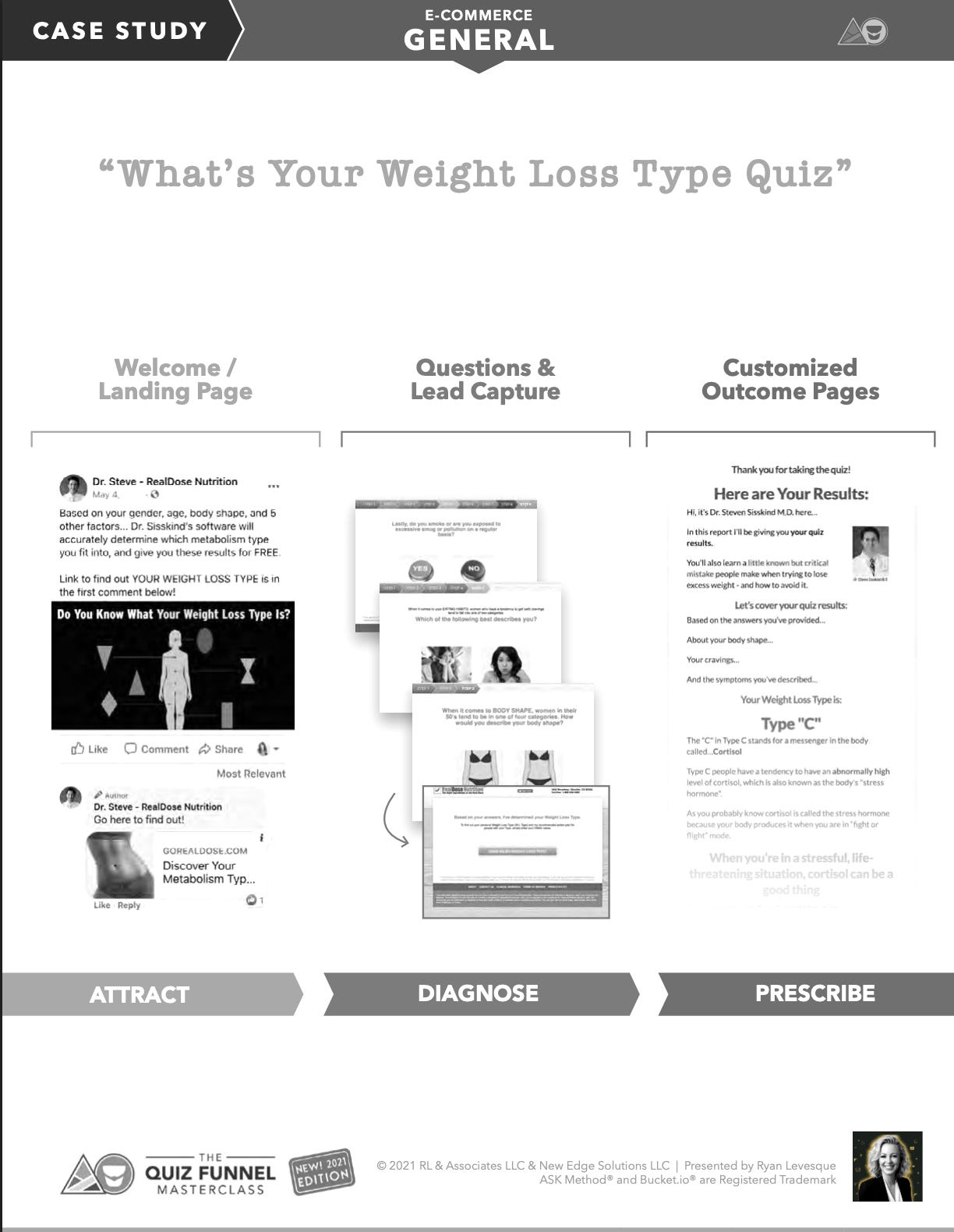
We built a “What’s Your Weight Loss Type?” quiz. Not a gimmick. Not a “which Hogwarts house are you” time-waster.
A diagnostic tool that did three things simultaneously:
1. Pre-qualified buyers without them realizing it
By asking questions about their habits, struggles, and goals, we filtered out the tire-kickers before they ever hit the sales page. Quiz completion rates for health audiences average 45-65% according to Outgrow’s 2026 benchmark data. Ours hit higher because we made every question feel like progress toward an answer they actually wanted.
2. Educated while we segmented
Each question taught something. “Do you struggle more with afternoon cravings or late-night snacking?” isn’t just data collection—it’s priming them to understand why the product works. The brand’s entire value proposition was built on science: clinically-studied ingredients targeting different metabolic mechanisms. The quiz let us match their specific problem to the specific mechanism. Not “this pill burns fat.” More like “your cortisol response to stress is sabotaging your metabolism—here’s the research, and here’s what addresses it.”
3. Stayed compliant by being genuinely useful
Meta’s policies are clear: no negative self-perception, no before-and-after transformations, no unrealistic promises. What they can’t ban is education. They can’t flag a quiz that helps someone understand their own biology. The ads didn’t say “lose weight.” They said “discover your weight loss type.” One is a promise. The other is a question.
Here’s What I Want You to Notice
Quiz funnels convert at 40.1% on average, according to Interact’s 2026 conversion rate report. That’s not a typo. Forty percent of people who start a well-designed quiz finish it and give you their email. Compare that to a standard lead magnet opt-in page, where you’re fighting for 20-30% if you’re lucky. Why the difference? Curiosity is more powerful than incentive. A PDF guide says, “Here’s information you might want.” A quiz says, “Here’s an answer about you that you can’t get anywhere else.” The second one wins every time.
The Funnel Architecture
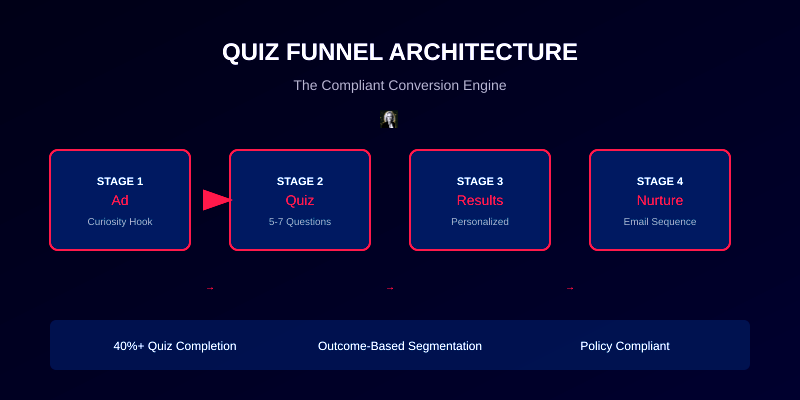
Stage 1: The Ad
Attention-grabbing creative that didn’t mention weight loss directly. Instead: “Why traditional diets fail 95% of people (and what actually works according to the science).” Mobile-friendly. No before-and-after images. No body shaming. Just a question worth clicking.
Stage 2: The Quiz
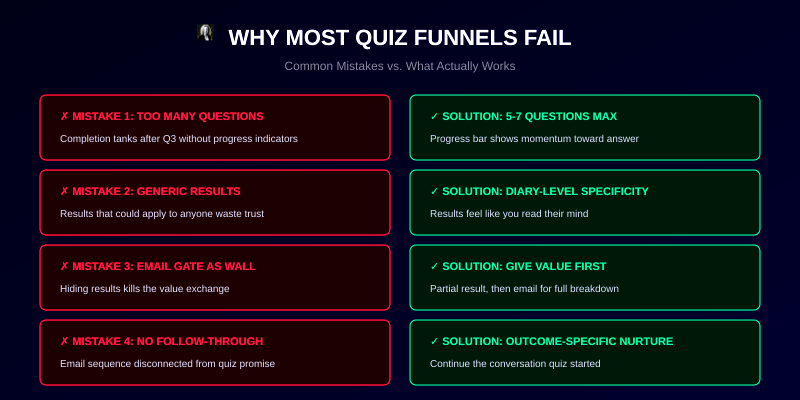
5-7 questions. Easy entry. Every answer is built toward the reveal. Critical detail: we used a progress bar. Seems small. Matters a lot. Quiz completion drops sharply after question 3 if people don’t know how close they are to their result.
Stage 3: The Results Page
This is where the magic happens. Each “weight loss type” had its own results page with: a personalized explanation of their specific challenge, the science behind why standard approaches hadn’t worked for them, and a product recommendation that matched their type. Not “buy this supplement.” More like “based on your answers, here’s why your body responds this way—and here’s what the research says can help.”
Stage 4: Email Nurture
The sale often didn’t happen on the first visit. We built outcome-specific email sequences that continued the education, highlighted customer success stories (social proof without before/after images), and guided prospects toward purchase over 5-7 touchpoints.
The Numbers
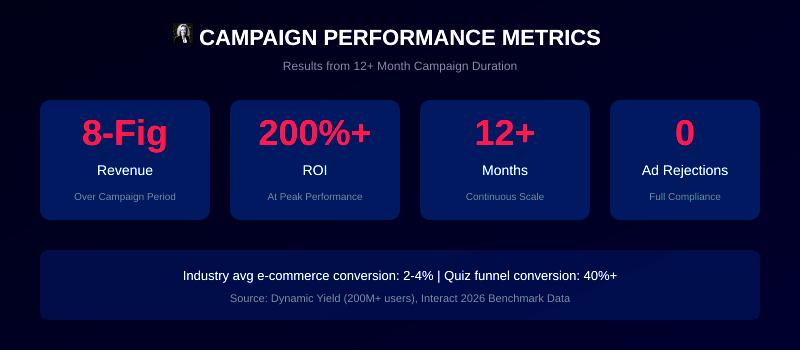
Let me put that in context. The average health/supplement brand on Meta is getting absolutely destroyed by compliance restrictions. 35 state attorneys general sent a letter to Meta in late 2024 demanding they actually enforce their own policies on misleading weight loss ads. The crackdown is real.
Meanwhile, this funnel scaled for over a year without a single ad rejection. Because we weren’t trying to sneak past the rules. We were building something genuinely valuable that happened to also be compliant.
Why Most Quiz Funnels Fail (And What We Did Differently)
Here’s where I get irritated. Everyone loves the idea of quiz funnels. Ryan Levesque built a whole empire teaching them. SnackNation credits its quiz for $24M in annual revenue. The data is clear: they work. So why do most marketers build bad ones?
What I’d Do Differently Now
More dynamic creative testing early. We found winning ad angles, but we could have found them faster with more structured testing on the front end.
Outcome-specific retargeting. Someone who scores as “stress-driven weight gain” should see different retargeting ads than someone flagged as “metabolism slowdown.” We did some of this. We could have done more.
Deeper behavioral tagging. With better analytics infrastructure, we could have tracked not just quiz completion but question-by-question engagement to optimize the funnel even further.
The Angry Strategist Take
Here’s what bothers me about health marketing in 2026: Everyone’s complaining about Meta’s policies. Nobody’s asking why those policies exist.
They exist because the industry earned them. Years of “lose 30 pounds in 30 days” garbage trained the platforms to assume the worst about anyone selling anything health-related.
The brands that win now are the ones who realize compliance isn’t a constraint—it’s a competitive moat.
When you build something genuinely valuable, you’re not fighting the algorithm. You’re aligned with what the platforms actually want: content that helps people without manipulating them. That’s not idealism. That’s just good strategy.
The Playbook
I’ve built similar architectures since, and I’m happy to walk through the methodology if you’re tackling something comparable. The strategy only works if you execute it. And most people won’t.
This campaign ran while most health brands were getting their accounts suspended. The principles haven’t changed. Meta’s enforcement has only gotten stricter. If anything, the quiz funnel advantage is bigger now than it was then. Because everyone else is still trying to run ads that say “lose weight.”
THE ANGRY STRATEGIST 🤟 Strategy without the bullsh!t.