
An Open Letter to the Architects of Illusion
A PSA for Those Who Build and Those Who Merely Perform (You know exactly who I'm talking about.) Go Go Captain™ Notes — Dec 02, 2025


Dear Leaders,
Every era produces two kinds of influence: those who build empires and those who build fog machines.
The digital age simply gave the fog machines better lighting and five-figure ticket prices.
You know who I’m talking about.
The “elite” rooms where half the attendees didn’t pay and the other half paid for proximity to people who also didn’t pay. The spiritual sales pitches that smell like incense and convert like clockwork. The “signature frameworks” that were last updated when Obama was in office. The industry disruptors who’ve disrupted nothing but their accountant’s expectations.
No names necessary. The archetype announces itself.
Here’s what’s interesting: I’ve been in those rooms.
Not in the audience.
In the engine room. The place where the metrics live, where the creative teams build the magic that gets credited to someone else’s “intuition,” where operators quietly fix what the visionary quietly broke.
I’ve watched borrowed strategy get blessed as breakthrough thinking at “live virtual events.”
I’ve seen the gap between what’s sold from the stage and what survives contact with reality.
That gap is getting harder to hide.

A Reality Check
Let me draw you a picture:
If you’ve built your empire on mystique, you should know: mystique has a half-life.
And we’re well past it.
The average “high-ticket mastermind” produces networking, not strategy.
The ROI lives in the photos, not the P&L.
The real work—the campaigns, the copy, the conversion architecture—gets done by teams who will never see a stage, building systems their leaders couldn’t explain under oath.
This isn’t bitterness.
It’s arithmetic.
The Economics of Fog
Let’s talk numbers. Because illusionists hate numbers.
The average high-ticket mastermind ($25K-$100K) delivers:
What you pay for:
Access to the “guru”
A private community
“Hot seat” coaching
Networking with other attendees
What you actually get:
2-3 hours of actual guru time (do the math on that hourly rate)
A Slack channel that goes quiet after 60 days
Networking with people as lost as you are
Photos for your Instagram
The conversion math:
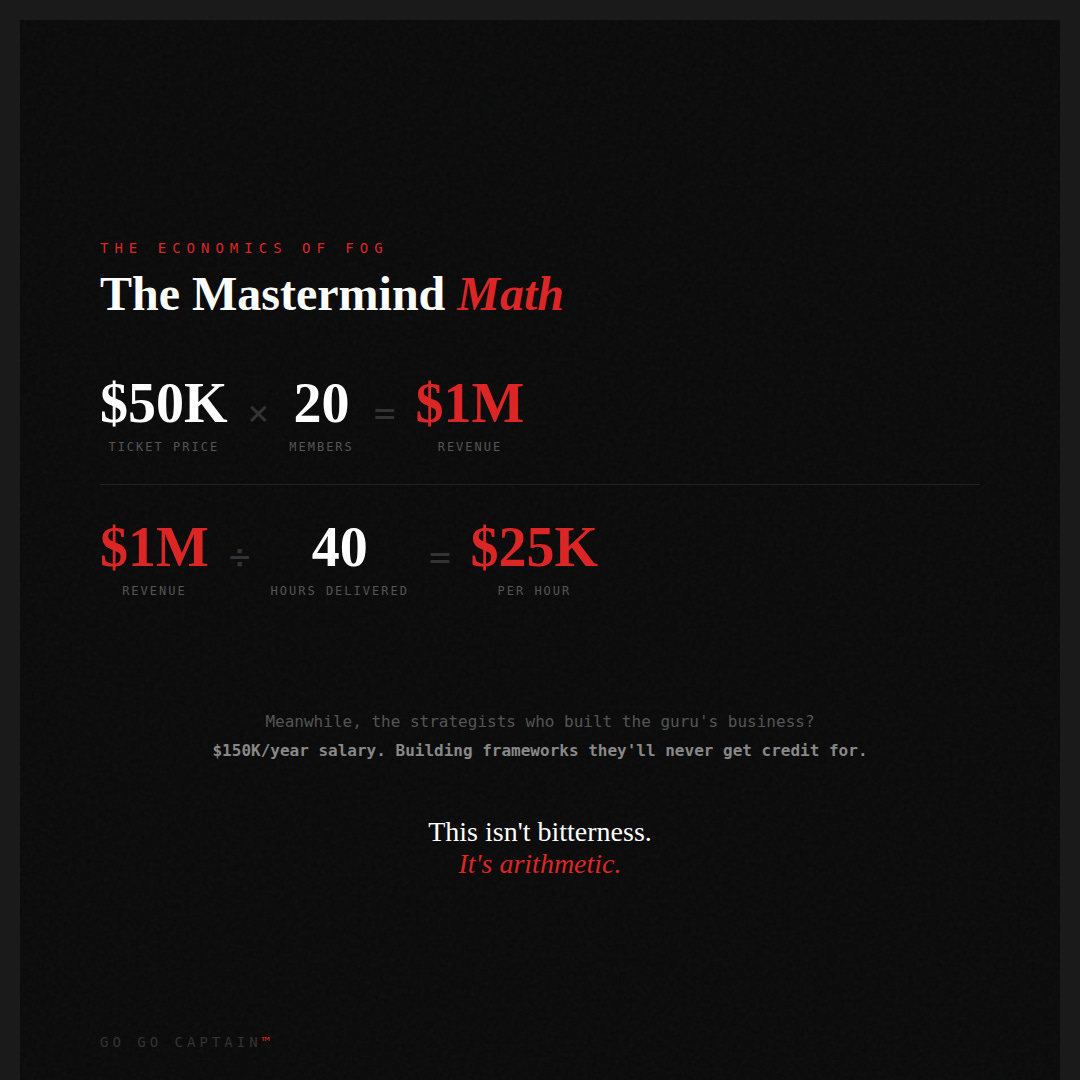
If a $50K mastermind has 20 people, that’s $1M in revenue.
The guru spends maybe 40 hours total on delivery.
That’s $25,000/hour.
Meanwhile, the actual strategists who built the guru’s business? They’re making $150K/year salary, building frameworks they’ll never get credit for, watching their work get presented as divine download.
This isn’t a criticism. It’s a business model.
The question is: which side of it are you on?
The Three Tells of an Illusionist
After fifteen years in rooms most people pay five-six figures just to photograph, I’ve learned to spot the difference between substance and theater in the first fifteen minutes.
Here’s the smoke detection guide:
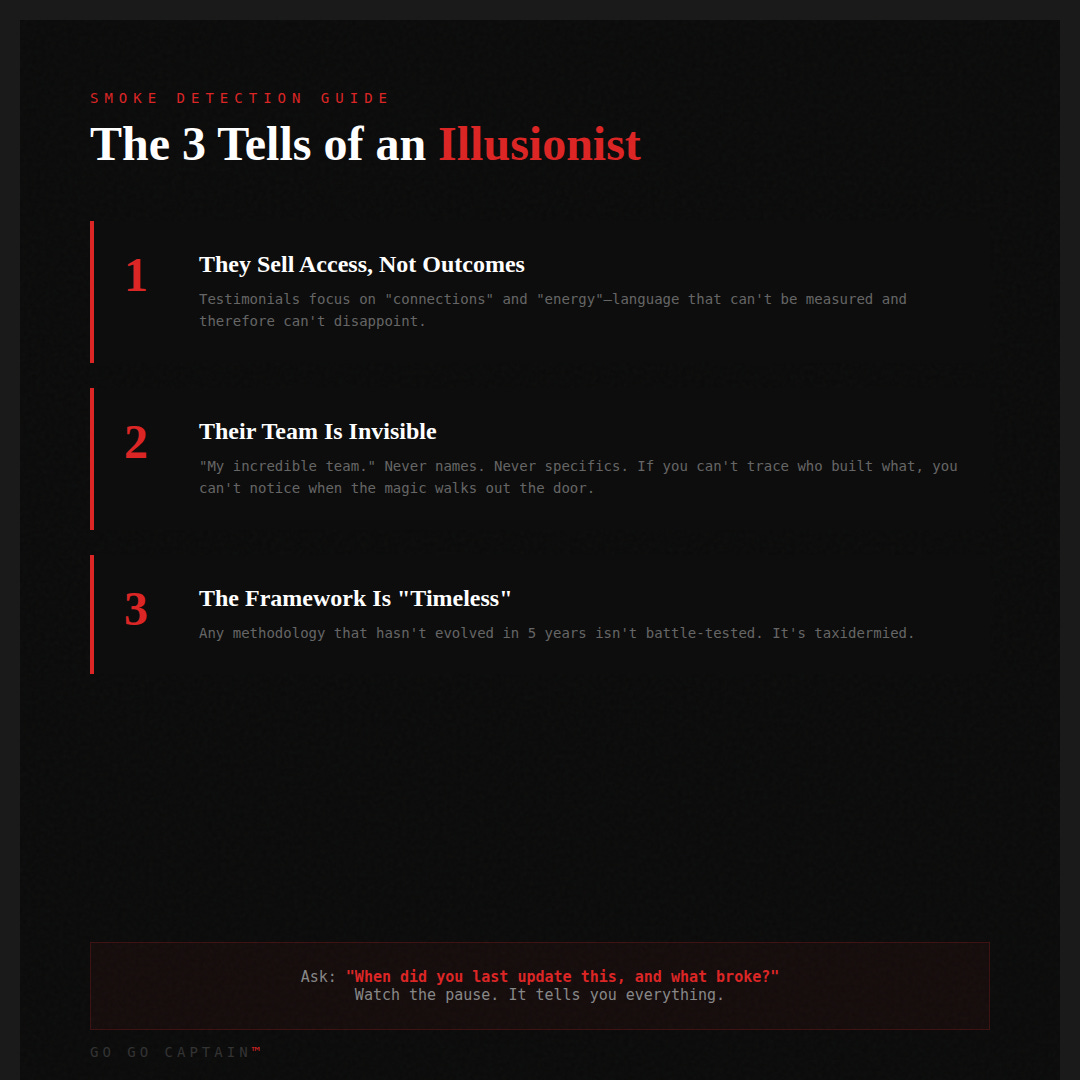
Tell #1: They Sell Access, Not Outcomes
The pitch centers on who you’ll meet, who you’ll be seen with, and whose contact info you’ll get.
The testimonials focus on “connections,” “energy,” and “mindset shifts”—language that can’t be measured and therefore can’t disappoint.
The diagnostic question:
“Can you point to a specific, measurable result your methodology produced? Not ‘my client had a seven-figure launch’—that’s their client’s work. What did YOUR framework contribute that the client couldn’t have done alone?”
If the answer is vague, the value is too.
Watch their face when you ask this. The pause tells you everything.
Tell #2: Their Team Is Invisible and Interchangeable
Watch the credits. Or rather, watch for the lack of them.
Illusionists present everything as flowing from their singular genius. The copywriter, strategist, campaign manager, and creative director are ghosts. If acknowledged at all, it’s generically.
“My incredible team.”
Never names. Never specifics. Never shared stage time.
This isn’t humility. It’s obfuscation.
If you can’t point to who built what, no one can trace the real source of the magic—or notice when it walks out the door.
I’ve watched “visionaries” lose their best operator and suddenly discover their “intuition” stopped working. Funny how that happens.
Tell #3: The Framework Hasn’t Been Pressure-Tested in Public
Here’s a question that makes illusionists sweat:
“When did you last update this methodology, and what broke that made you change it?”
Builders iterate publicly. They talk about what failed. They credit the operators who caught the problem. They show version histories.
Illusionists present their frameworks as received wisdom. Timeless. Complete. Beyond question.
That’s not confidence. That’s a tell.
Osho said: “The moment you become certain, you become dead.”
Any framework that hasn’t evolved in five years isn’t battle-tested. It’s taxidermied.
The Fog Machine Business Model
Let me show you how the illusion industry actually works:
Stage 1: The Origin Story
Every illusionist has one. Usually involves:
Rock bottom moment (bankruptcy, divorce, health crisis)
Mystical awakening or mentor appearance
Rapid transformation
Now they want to help YOU
The story is designed to create emotional resonance, not communicate methodology.
Stage 2: The Borrowed Framework
Take an existing concept. Rename it. Add three steps. Call it proprietary.
Examples:
Basic goal-setting → “The Vision Activation Protocol™”
Sales fundamentals → “The Heart-Centered Conversion Method™”
Content repurposing → “The Omnipresence Engine™”
The trademark symbol does a lot of heavy lifting here.
Stage 3: The Social Proof Stack
Photos with celebrities. Screenshots of revenue. Testimonials about “transformation.”
Notice what’s missing: specific, measurable outcomes attributed to specific, explainable methodology.
Stage 4: The Ascension Ladder
Free content → Paid course → Group coaching → Mastermind → Inner circle
Each level promises access to the “real” secrets
The “real” secrets are just more networking with people who paid more
Stage 5: The Exit
Sell the business, license the framework, or transition to “legacy” mode where you speak at conferences about success you can no longer replicate.
This is not a critique. This is a business model.

Some people run it with integrity. Most don’t.
What Actually Works: A Builder’s Playbook
For the leaders still interested in substance over theater, here’s the operational shift that separates architects from actors.
1. The Quarterly Circle Audit
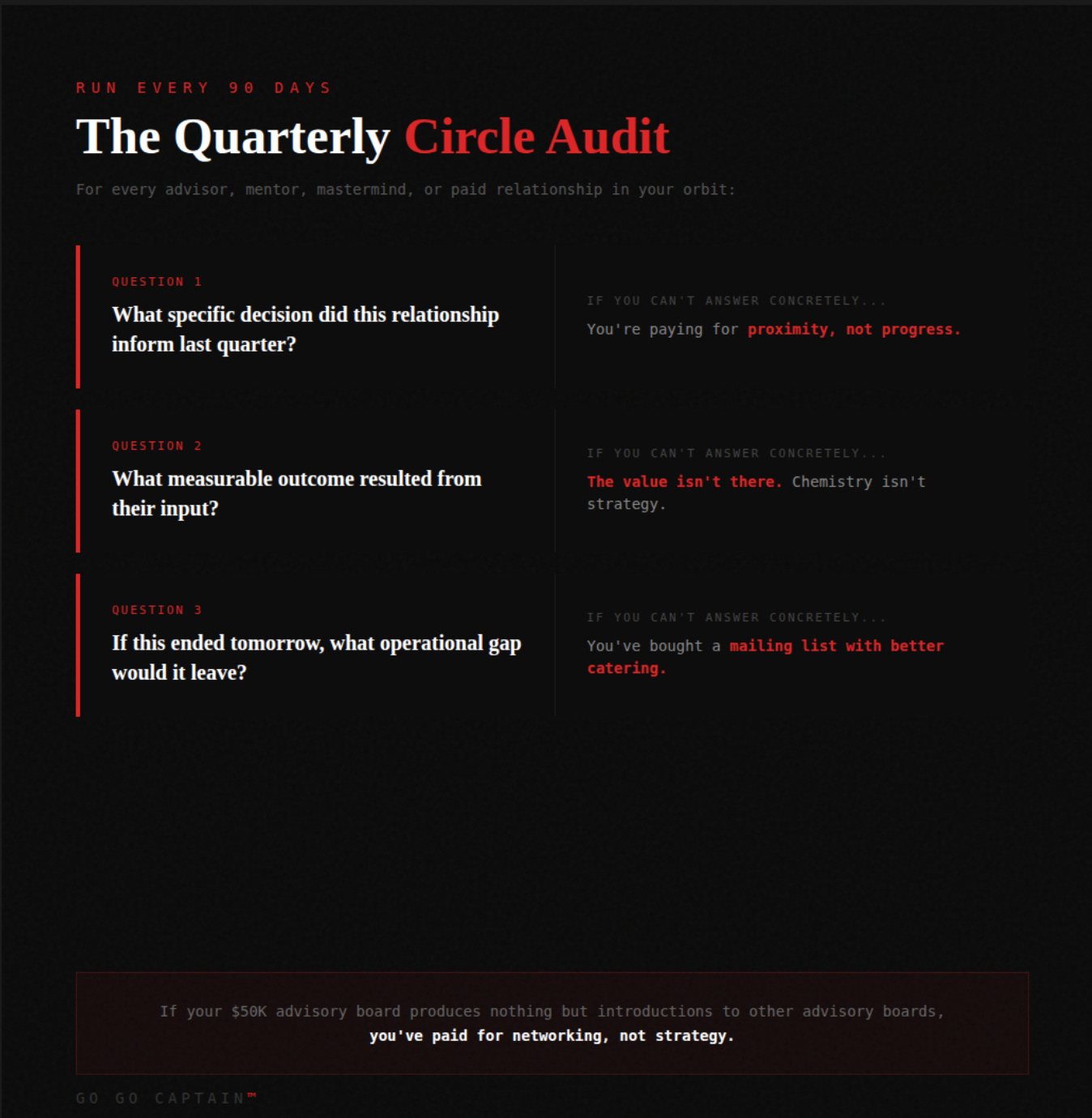
Every 90 days, run this on every advisor, mentor, mastermind, or paid relationship:
The 10/80/10 Rule for your inner circle:
10% Visionaries — Big-picture thinkers, pattern-matchers, market readers
80% Operators — People actively building, shipping, measuring, iterating
10% Wildcards — Outside your industry, different perspectives, creative chaos
Most illusionist circles are 80% visionaries, 15% yes-men, and 5% whoever paid the most.
If everyone in your room has a podcast but no one has a P&L, you’re in a content club, not a strategic council.
2. The Credit Audit
Review your last ten pieces of public content. Count how many times you:
Named a specific team member’s contribution
Shared credit for an idea or outcome
Put someone else’s expertise ahead of your own narrative
If the count is low, you’re not leading. You’re performing.
Implement a rotating spotlight. Once a month minimum, the person who built the thing presents the thing.
Not “here’s my brilliant team”—that’s still you-centered.
Actually hand over the mic. Let them own the explanation, the wins, and the lessons from what didn’t work.
3. The Framework Integrity Test
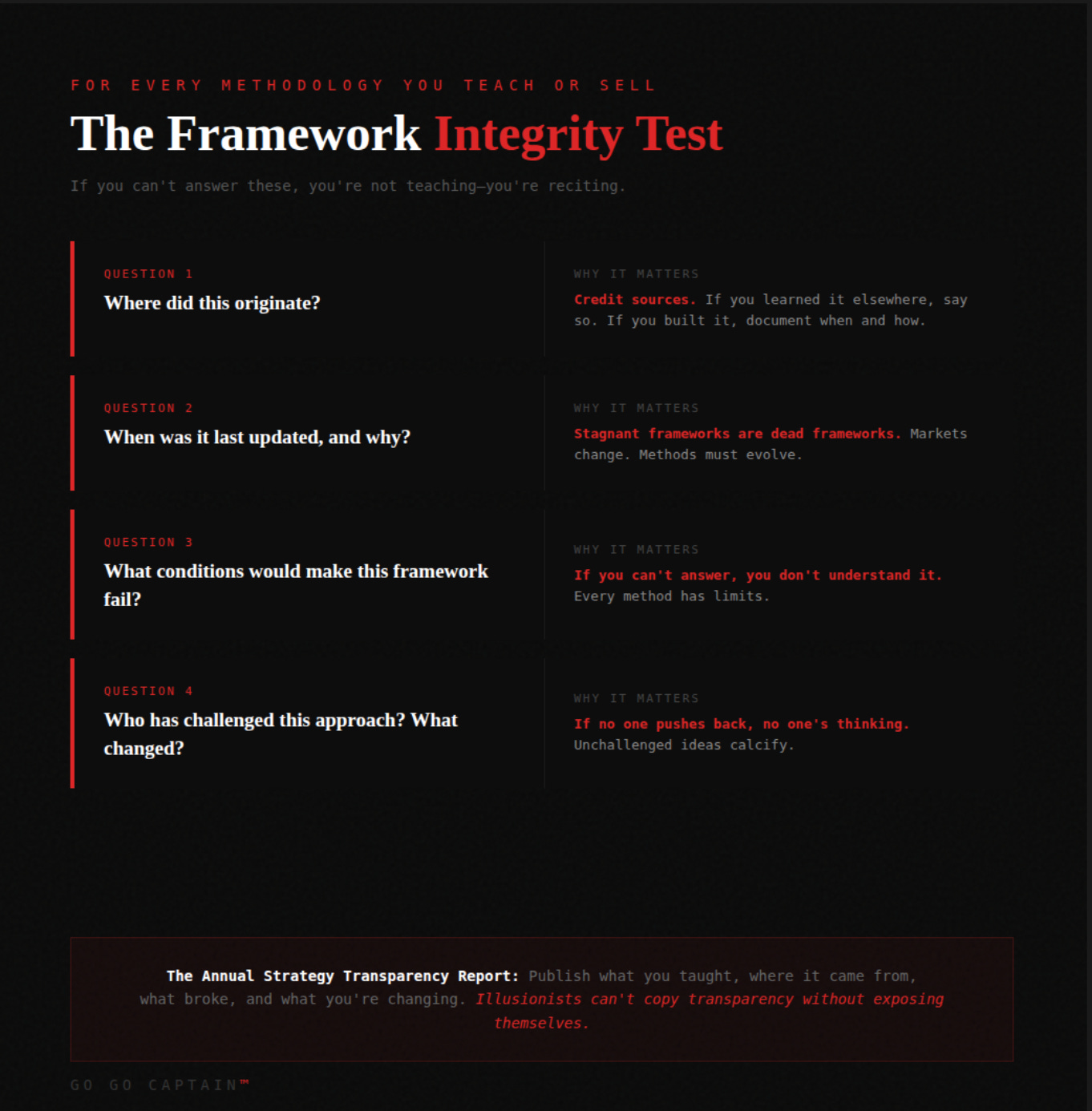
For every methodology you teach, sell, or reference:
QuestionWhy It MattersWhere did this originate?Credit sources. Document your own R&D.When was it last updated, and why?Stagnant frameworks are dead frameworks.What conditions would make this fail?If you can’t answer, you don’t understand it.Who has challenged this approach? What changed?If no one pushes back, no one’s thinking.
The Annual Strategy Transparency Report:
Once a year, publish:
What you taught/sold this year
Where those ideas came from
What you tested and what broke
What you’re updating for next year and why
No one does this. That’s exactly why you should.
Transparency is the ultimate competitive moat because illusionists can’t copy it without exposing themselves.
4. The ROI Framework for Paid Relationships
Before joining any high-ticket program, define in writing:
Three specific decisions you expect this investment to inform
The timeline for those decisions
The measurable outcome that would make this “worth it”
After 90 days, audit against those criteria.
Not “I feel more confident”—what happened in your business that traces back to this investment?
If you can’t draw the line, the value isn’t there.
Chemistry isn’t strategy.
5. The Proof Stack (Before the Personal Brand)
Illusionists build audience first, proof later (or never).
Builders do the opposite.
Before you scale visibility, you should have:
Specific, named results from your methodology
Case studies that include what didn’t work
Third-party validation referencing specific outcomes, not vibes
Public iteration showing your thinking evolves
Attention is easy to buy. Trust is earned through evidence over time.
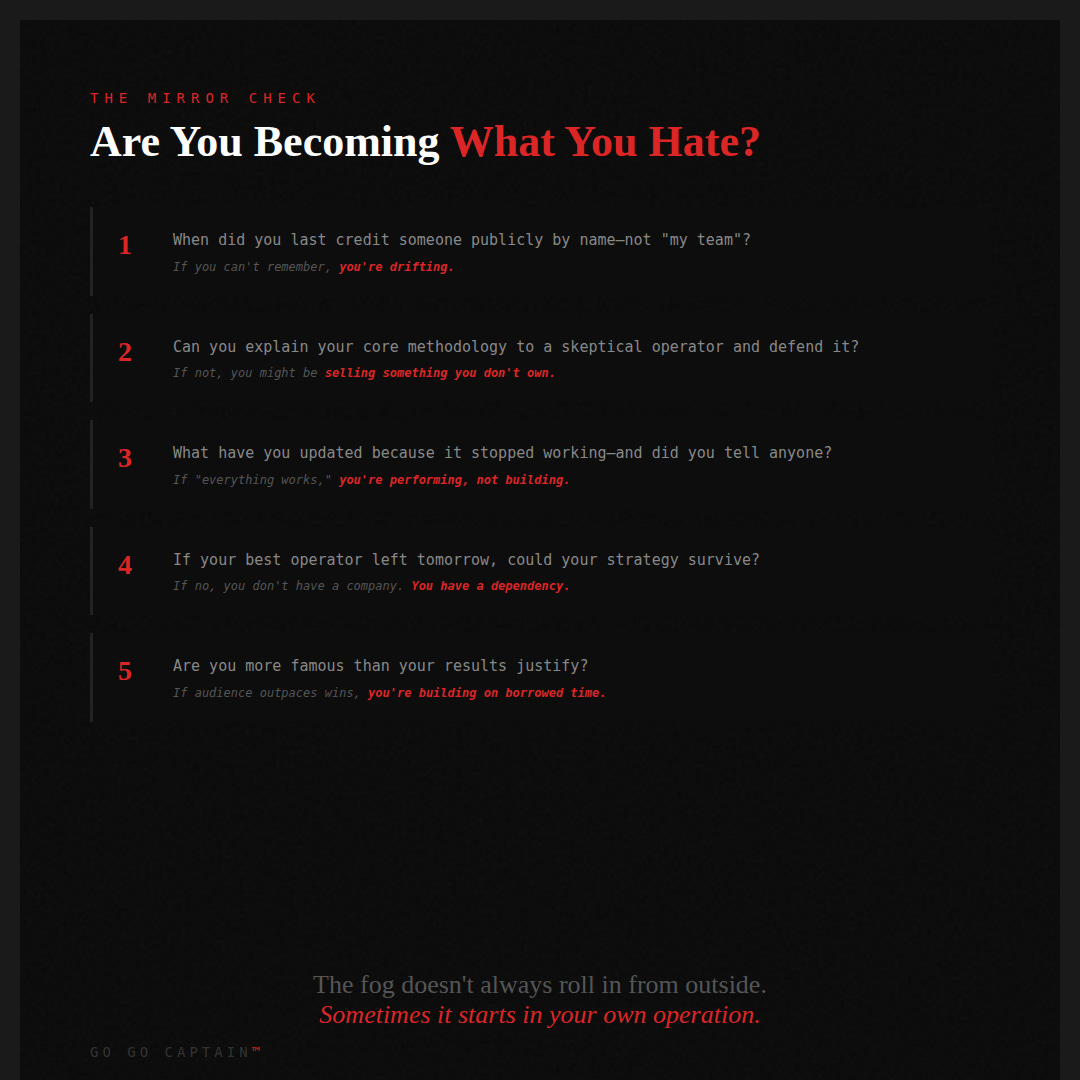
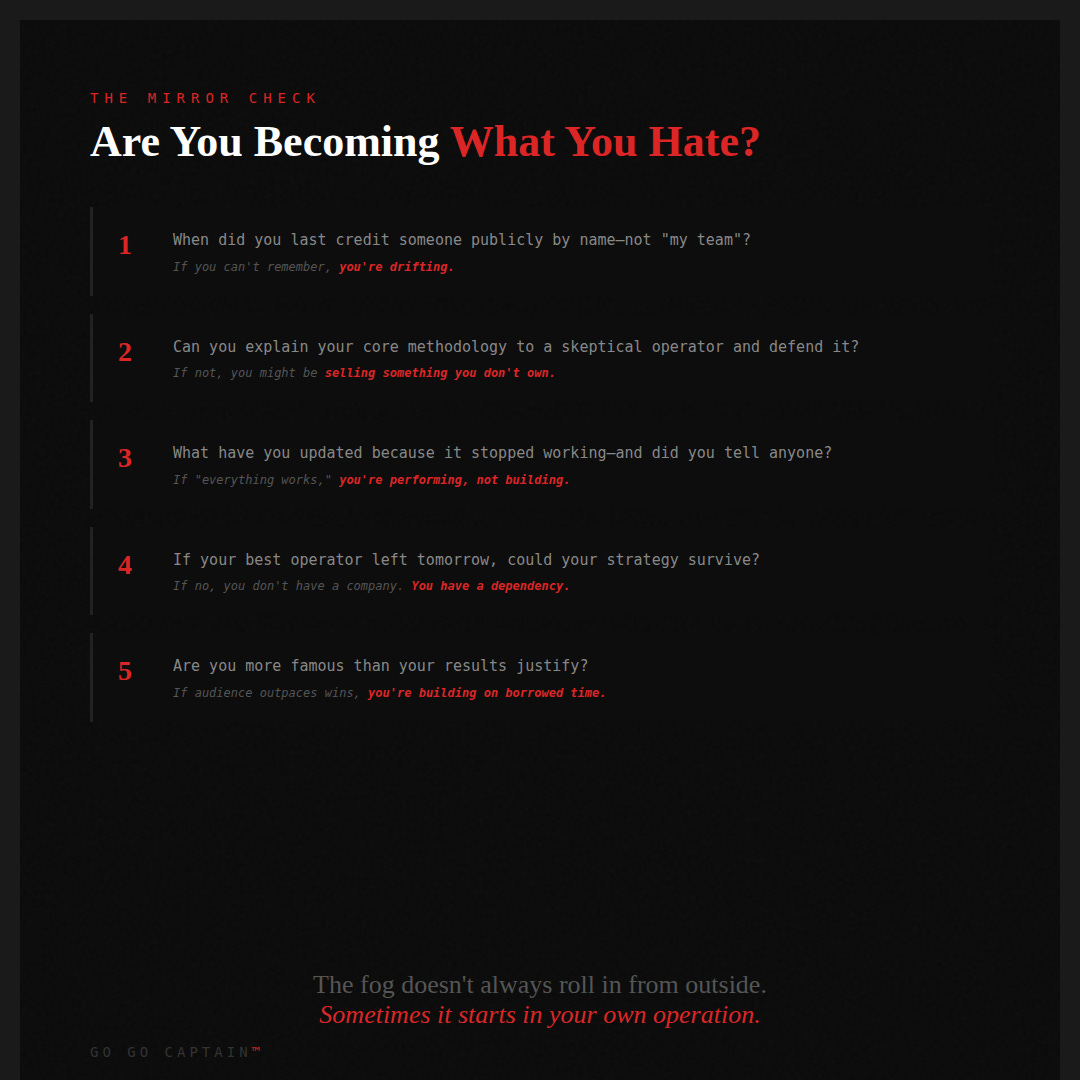
The Self-Audit: Are You Becoming What You Hate?
Here’s the uncomfortable part.
The fog doesn’t always roll in from outside. Sometimes it starts in your own operation.
Fifteen years in marketing has taught me that the line between builder and illusionist isn’t fixed. It’s a spectrum, and pressure pushes people in the wrong direction.
The quarter’s short. The launch is behind. The audience wants the simple story, not the complicated truth.
So here’s the mirror check. Answer honestly:
1. When did you last credit someone publicly by name—not “my team”—for a specific contribution?
If you can’t remember, you’re drifting.
2. Can you explain your core methodology without notes to a skeptical operator, and defend it under questioning?
If not, you might be selling something you don’t fully own.
3. What have you updated in the last year because it stopped working—and did you tell anyone?
If your public narrative is “everything I touch works,” you’re performing, not building.
4. If your best operator left tomorrow, could your strategy survive?
If the answer is no, you don’t have a company. You have a dependency.
5. Are you more famous than your results justify?
This one stings. But attention scales faster than outcomes these days. If your audience growth has outpaced your documented wins, you’re building on borrowed time.
The Market Is Shifting
Here’s what the data shows:
Trust in influencers is declining. Edelman’s Trust Barometer shows only 38% of people trust influencer recommendations, down from 51% five years ago.
Audiences are getting more sophisticated. The “guru” model that worked 2015-2020 is showing cracks. People want proof, not promises.
Operator talent is comparing notes. The best strategists, copywriters, and campaign managers are talking to each other. They know who actually does the work and who just presents it.
AI is exposing borrowed frameworks. When ChatGPT can generate your “proprietary method” in 30 seconds, the mystique evaporates.
We’re entering the era of the Builder CEO. The Architect CEO.
Leaders who trade mystique for mastery and influence for infrastructure.
Leaders who can explain their own strategy without a ghostwriter present.
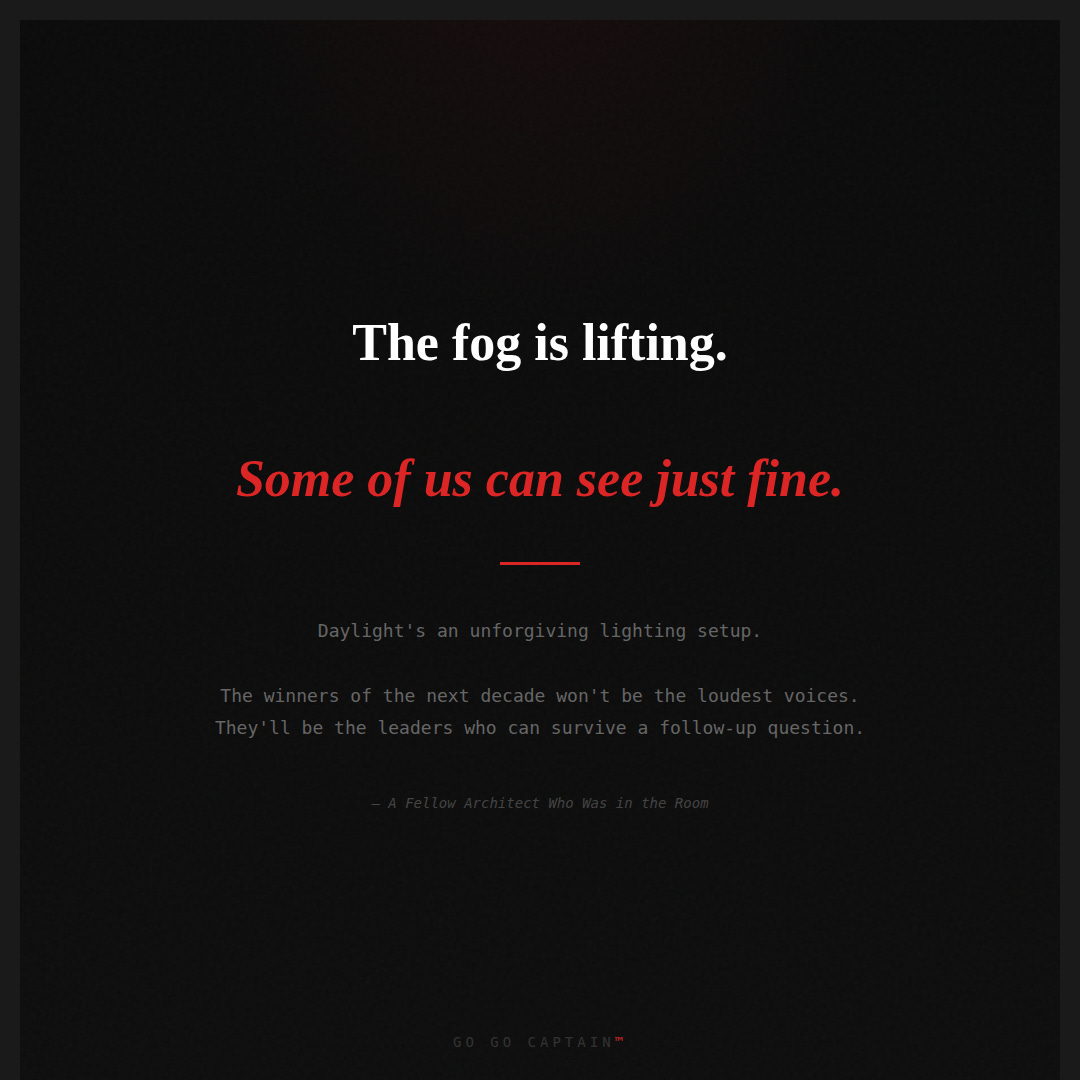
The winners of the next decade won’t be the loudest voices or the biggest audiences. They’ll be the leaders who can survive a follow-up question, whose teams stick around after the equity vests, whose methodology actually works when someone else runs it.
The game is changing. Build accordingly.
To the Real Ones
If you’re building with integrity, keep going. The market is correcting in your favor.
If you’re building with smoke—well. Daylight’s an unforgiving lighting setup.
And to everyone exhausted by the circus: you deserve frameworks rooted in data, teams rooted in empowerment, and leadership that can survive a follow-up question.
The fog is lifting. Some of us can see just fine.
With clarity, a raised eyebrow, and receipts,
A Fellow Architect Who Was in the Room
P.S. — I see you, and you are never alone.
If this resonated, share it with someone still lost in the fog. If it made you uncomfortable, sit with that. Subscribe for more uncomfortable clarity.